Friday, October 14, 2011

Consumer Sentiment declines in October

"The preliminary October Reuters / University of Michigan consumer sentiment index declined to 57.5 from 59.4 in September..."

Consumer Sentiment

at http://www.calculatedriskblog.com/2011/10/consumer-sentiment-declines-in-october.html?utm_source=feedburner&utm_medium=feed&utm_campaign=Feed%3A+CalculatedRisk+%28Calculated+Risk%29

More Alarming Shipping News and Charts: Railfax Railroad, Ceridian Trucking, Harper-Petersen Shipping; Reader Anecdotes

"Weak shipping reports have now spread to rail traffic, truck traffic, and ocean shipping. We will look at each of those in turn, but first a brief recap on the Unprecedented Drop in Port Traffic: A Sobering Omen for Holiday Sales.

The five busiest container ports in the United States said that imports in August 2011 were lower than or even with 2010 volumes. In Long Beach, the second-busiest container port by volume, August imports fell by 14.2 percent from August 2010..."

at http://globaleconomicanalysis.blogspot.com/2011/10/more-alarming-shipping-news-railfax.html?utm_source=feedburner&utm_medium=feed&utm_campaign=Feed%3A+MishsGlobalEconomicTrendAnalysis+%28Mish%27s+Global+Economic+Trend+Analysis%29

French Government Bond Yields Widen to Record vs. Germany; Portugal Faces National Emergency; Trichet Says "ECB Will Not Be Lender of Last Resort"

"Credit stress has now hit France sovereign debt. The spread between 10-year French bonds and German government bonds is at a Euro-era record 97 basis point differential..."

France 10-Year Government Bonds


Germany 10-Year Government Bonds


at http://globaleconomicanalysis.blogspot.com/2011/10/french-government-bond-yields-widen-to.html?utm_source=feedburner&utm_medium=feed&utm_campaign=Feed%3A+MishsGlobalEconomicTrendAnalysis+%28Mish%27s+Global+Economic+Trend+Analysis%29

Wednesday, October 12, 2011

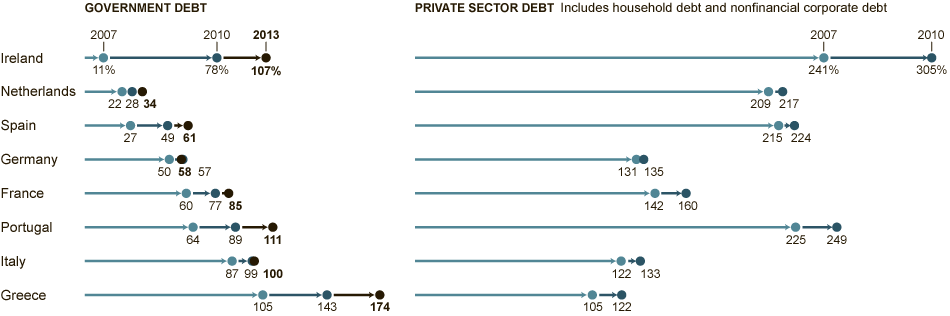
Debt Levels Alone Don’t Tell the Whole Story

"Net debt as a percentage of G.D.P.

The charts show debt figures for 2007 and 2010 for eight members of the euro zone, expressed as a percentage of gross domestic product for both the public and private sectors, and I.M.F. forecasts for public sector debt in 2013."

Click for lager chart:


at http://www.ritholtz.com/blog/2011/10/debt-levels-alone-don%e2%80%99t-tell-the-whole-story/

Erste’s fumble, and where (else) to hide sovereign marks

"Those helpful sea creaturesat Goldman Sachs have called 36 banks to see if any of them were treating CDS protection sold in the same way that Erste Group was.
To recap, Erste announced a number of extraordinary charges on Monday, one of which acknowledged that their accounting treatment for CDS was.. err.. wrong. An admission that rightly led the analysts at Goldman to question, “who else might be making the same mistake?”..."

at http://ftalphaville.ft.com/blog/2011/10/12/700401/erstes-fumble-and-where-else-to-hide-sovereign-marks/

Weak 10 Year Auction Saved By Primary Dealers Taking Down Most Since May 2009

"Today's $21 billion 10 Year reopening was not pretty. First, the tail was a notable 3 bps with the When Issued trading at 2.24%, ahead of the auction pricing a disappointing 2.27%, well above the record low 2.00% from September, although still materially lower than average yields in the past year. As troubling was the Bid To Cover which came at 2.86 or the lowest since November 2010's 2.80 (compared to the LTM 3.10). Then looking at the internals should be a cause of concern for anyone who believes that China will not retaliate for the currency bill passed yesterday by Congress, after Indirects took down just 35.0% of the full $21 billion, the lowest since February 2010, at a 81% hit rate...."

at http://www.zerohedge.com/news/weak-10-year-auction-saved-primary-dealers-taking-down-most-may-2009

Guest Post: To EFSF Or Not To EFSF - A Franco-German Drama

"with simultaneous translation from Euro-lingo into plain English)
  • 4:05: “Direct help for bank recapitalization from EFSF is not at all doable” – German Economy Minister (Translation: “Frogs, I thought we told you already, your plan doesn’t fly”)

  • 6:00: “It is important to us that all banks are equipped for all
    eventualities and must go to market first for capital” – German Finance
    Minister (Translation: “May be they’ll understand if I say it – nobody seems to take Roesler serious”)

  • 6:19: “There is no doubt on the soundness of French banks” – French government (Translation: “Hopefully the dim-wits at Agence France-Presse will print my statement without embarrassing typos”)

  • 6:20: “Private capital must have priority, but French state is ready
    to respond to banks’ capital needs is necessary” – French government (Translation: “Nobody will figure out that this does not match what I said one minute ago”)

  • 6:20: France wants collective, European response to the recapitalization of European banks – French government (Translation: “Let’s see if the Germans respond if I say this”)

  • 6:31: France won’t use the EFSF to recapitalize banks – French government (Translation: “Okay okay, no need to scream like that on the phone”) "
at http://www.zerohedge.com/news/guest-post-efsf-or-not-efsf-franco-german-drama

Monday, October 10, 2011

The mystery of US banks’ second mortgage exposure

"How big a hit should US banks take on their second mortgage portfolio?
A question that’s been asked again and again (and again and again) by this blog and others. Regulators are worried: Bloomberg reported last month that the Fed and the OCC are checking whether banks have put aside enough reserves to cover losses.

The second mortgage problem is, in theory, fairly simple. During the housing boom, some mortgage holders used their (increasingly valuable) house as collateral for a home equity loan to pay for another home, college fees, and so on. If, following the housing market crash and the recession, they now go into delinquency or default, the lender of the first mortgage should be senior and receive first claim on the remaining assets. The second lender can be left with little or nothing if the value of the home has fallen under the amount of the first loan. In this case the holders of these mortgages should ‘fess up and set aside the corresponding loan loss reserves.

However, this is a mash-up between the US housing market and financial system, so few things are straightforward. The Treasury’s maligned Hamp programme in effect switched the priority order. Banks are some of the biggest holders of second mortgages and there’s little incentive for them to collaborate with first mortgage holders. In many cases banks are also mortgage servicers so there’s even less incentive for them to take losses on second mortgages. Indeed, in many cases, servicers were reported to be pushing for second lien payment even when the first was not forthcoming. Thus there’s not been a lot of writing down going down, hence the regulators’ concern..."

at  http://ftalphaville.ft.com/blog/2011/10/10/696591/the-mystery-of-us-banks-second-mortgage-exposure/

EUROPE – SETTING UP TO BE THE NEXT JAPAN

"The euro zone is caught between a rock and a hard place.

The region’s leaders have two options: Member nations can let countries default, write down their debts, renegotiate bonds to an affordable repayment level and take a painful hit now, or they can squash growth for years, perhaps even decades, all in the name of austerity.

Despite its leaders’ promises to defend the monetary union, the long delay in confronting the insolvency of its most deeply indebted members suggests that Europe is choosing the latter. That’s a decision that will plague it for a long time. The continent will begin to look like Japan..."

at http://pragcap.com/europe-setting-up-to-be-the-next-japan

Portugal Central Bank Warns of Fiscal Deficit Slippage and Recession; Greek 1-Year Yield Tops 150%

"Via email, Barclays Capital offered thoughts on "Potential Fiscal Slippage" in Portugal.
The Central Bank of Portugal warned the economy might fail to meet budget deficit targets set for this year and next under the EU/IMF programme (5.9% and 4.5% of GDP, respectively), unless it takes "significant additional measures".

Contraction Two More Years

According to the report, lower-than-previously projected GDP growth and lack of implementation of structural reforms (as opposed to one-off actions) would be responsible for the anticipated fiscal slippage in 2012. The Central Bank expects GDP growth to contract 1.9% this year (BarCap: -2.0%, EU/IMF: -2.0%) and 2.2% next (previous forecast: 1.9%, BarCap: -1.7%, EU/IMF: -1.8%)..."
at  http://globaleconomicanalysis.blogspot.com/2011/10/portugal-central-bank-warns-of-fiscal.html?utm_source=feedburner&utm_medium=feed&utm_campaign=Feed%3A+MishsGlobalEconomicTrendAnalysis+%28Mish%27s+Global+Economic+Trend+Analysis%29

Erste Group Reveals Stunner: Reports Billions In Previously Undisclosed Underwater Sovereign CDS; Who Is Next? And How Much More Is Out There?

"Anyone looking at a heatmap of European markets today will see a sea of green punctuated by a very red island in the middle. The culprit: Austrian mega bank Erste, which issued an ad hoc and very unexpected press release, in which it warned that losses in its Hungarian and Romanian books would lead to a 14% hit, or €1.1 billion, to tangible book value, something that in itself is not a surprise to anyone (except the stress test). After all, since early 2010, most have known that due to Swiss Franc-based mortgage exposure, Hungary is next to follow in the PIIGS footsteps, and its collapse has so far been delayed due to lower overall public and private sector leverage. What was, however not only a surprise, but a shock, was that Erste disclosed some major losses on its €5.2 billion CDS portfolio, consisting of "EUR 2.4 billion related to financial institution exposures, and EUR 2.8 billion related sovereign exposures". Why is this a surprise? UK-based financial advisory Autonomous explains: "The fact that Erste had a sovereign CDS portfolio which was not marked-to-market has left many investors scratching their heads. As a reminder the EBA stress test data showed Erste to have zero sovereign CDS exposure within its sovereign mix compared to the €2.8bn it now appears to have ‘fessed up’ to (taking a cumulative €460m hit). They also have €2.4bn exposure to banks via writing of CDS. The bulk is non-PIIGS but banks spreads have moved in the same manner as sovereigns (albeit wider and more volatile)." And there you have it: the bogeyman that everyone has been warning about, yet nobody has seen, CDS written (as in sold) in bulk against other sovereigns and other banks which up until now were only mythical, as they, to quote the EBA (which had Dexia as its safest bank) simply did not exist. Oh, they exist all right, and what they do is create a toxic spiral of accentuating losses whenever the risk situation deteriorates, creating positive feedback loops of ever increasing losses until the next Dexia appears... and then the next... and the next. Expect the market to latch on to this dramatic revelation like a rabid pitbull once the hopium high from today's EURUSD short covering squeeze wears off.

Still, this does not answer the question how Erste managed to squeeze this information by its auditors and the regulators, without having broken most public company, not to mention bank, laws. The answer is simple: the accountants let them do it.

Autonomous with more:

Note the EBA only required banks to declare CDS exposures in its trading book (Erste was not trading these but rather holding them as “credit surrogates”) so they could argue their exposures were strictly speaking correctly disclosed to the EBA. It seems Erste has changed their classification following an IASB paper from July. There is a link to the paper below where the relevant paragraphs appear to be 59-63 - Erste believed previously they were ‘financial guarantees’. With reference to paragraph 62 specifically, our in house accounting expert, notes that CDS do not meet the criteria for designation as a guarantee (as a guarantee must apply to a specific referenced asset held by the buyer rather than simply a referenced name). This isn't something there should expect confusion over - the starting point for all derivatives accounting is FVTPL, with any hedge accounting simply changing where the movements are recorded. Thus the decision to treat these positions as ‘guarantees’ should be considered a very “aggressive” approach.

And, logically, the two immediate follow up questions are 1) who else and 2) how much:

It also raises two broader questions - the scale of protection that has been sold by other banks across Europe and how many other banks have deployed Erste’s accounting approach (and will now be forced to move to mark-to market)? On the latter we have calls in with all the banks we cover cross Europe (more later). On the former I remind you the disclosure on sovereign CDS was a major disappointment in the EBA stress test in July. Despite investor hopes / market pressure at the time, the EBA presented the data in a way which rendered the information almost meaningless. It showed the net of positive market values and negative market values with no data on the notional value of positions. Market values of PIIGS derivatives exposures according to the EBA data ranged between €1.5bn for BNP Paribas and (€800mn) for LBBW.
As we identified in our note at the time (see page 15 - link below) the problem is that the net market value can change very quickly and unfortunately we remain totally in the dark on who has written what. The BIS data is equally as unhelpful - in its latest Quarterly Review (link below), the BIS explained how complicated the data is and how impossible it is to unravel who has written what. This is an obviou

So while Erste group is getting pummeled for being the first to be truthful, granted under duress, with its book exposure, this is merely the first of hundreds, if not thousands, of banks that it will be revealed in the coming weeks and months wrote hundreds of billions of CDS on sovereigns that have since soared to stratospheric levels. While on one hand ISDA may show up and once again make it clear that it only works for bank interests, reconfirming it would never declare a sovereign credit event (for more on the traditional CDS triggers see table below), the truth is that Erste, and soon many other banks' counterparties will demand a pound of flesh in daily variation margin, for even the tiniest amount of CDS exposure, which in turn will lead to a sudden and very dramatic liquidity crunch as unlike quarterly reporting where banks can fudge numbers and data all they want, when it comes to counterparty exposure, other banks know better than anyone just how bad the bank on the other side of the phone is. And will act accordingly.

Expect many more risk flaring episodes in the weeks ahead once this revelation is properly digested.

And as noted above, while probably very much irrelevant now that IDSA has made it clear in the aftermath of Greece it is merely a figurehead for various banking interests, and will never pronounce a sovereign EOD, here is what in theory, should trigger credit events for various types of CDS..."

at http://www.zerohedge.com/news/erste-group-reveals-stunner-reports-billions-previously-undisclosed-underwater-sovereign-cds-wh?utm_source=feedburner&utm_medium=feed&utm_campaign=Feed%3A+zerohedge%2Ffeed+%28zero+hedge+-+on+a+long+enough+timeline%2C+the+survival+rate+for+everyone+drops+to+zero%29

Friday, October 7, 2011

The 1930s, and Worse

"Good msing from Paul Mason of BBC on how we make things worse from here:
So then, in the absence of decisive policy action, you get a sequence that goes: crash (2008); stimulus (2009); failure of stimulus (2011); second crash (2011/12); deflation; involuntary collapse of globalisation. In that situation, which I profoundly hope does not happen, every government becomes like the Brüning administration in Germany after 1931, still trying to make the old policy work in the new world, increasingly resorting to decree..."
at  http://paul.kedrosky.com/archives/2011/10/the-1930s-and-worse.html?utm_source=feedburner&utm_medium=feed&utm_campaign=Feed%3A+InfectiousGreed+%28Paul+Kedrosky%27s+Infectious+Greed%29

The Rise of the Renminbi as International Currency: Historical Precedents

"All of a sudden, the renminbi is being touted as the next big international currency. Just in the last year or two, the Chinese currency has begun to internationalize along a number of dimensions. A RMB bond market has grown rapidly in Hong Kong, and one in RMB bank deposits. Some of China’s international trade is now invoiced in the currency. Foreign central banks have been able to hold RMB since August 2010, with Malaysia going first.

Some are now claiming that the renminbi could overtake the dollar for the number one slot in the international currency rankings within a decade (especially Subramanian 2011a, p.19; 2011b). The basis of this prediction is, first, the likelihood that the Chinese economy will surpass the US economy in size and, second, the historical precedent when the dollar overtook the pound sterling as the number one international currency during the period after World War I.

It used to be thought that international currency status was subject to much inertia (e.g., Krugman, 1984). There was said to have been a long lag between the date when the US economy had passed the UK economy with respect to size (1872, by the criterion of GNP) and the time when the dollar had passed the pound (1946, by the criterion of shares in central banks’ holdings of reserves).
The “new view,” represented in particular by Eichengreen (2011) and Eichengreen and Flandreau (2010), is that the lag was in fact rather short. It took until World War I for the dollar to fulfill the criteria of an international currency. Furthermore, the date when the dollar is said to have come to rival the pound in importance has now been moved up to the mid-1920s. The first point is right. If trade is the measure of size, the US first caught up with the UK during World War I. The US did not even have a permanent central bank until 1913. The other important criteria came soon thereafter: creditor status for the country; the perceived prospects for the currency to remain strong in value; and deep, liquid, open financial markets. (I have discussed the criteria in earlier papers. Chinn and Frankel, 2007, evaluate them econometrically and give further references.) The second point seems a matter of whether or not one wants to distinguish between the concept of “coming to rival” / “catching up with” the pound (1920s) versus the phenomenon of definitively “pulling ahead” / “displacing” the pound (1945). Under either interpretation, the dollar’s initial rise as an international currency was indeed rapid, once the conditions were in place..."

at  http://content.ksg.harvard.edu/blog/jeff_frankels_weblog/2011/10/06/the-rise-of-the-renminbi-as-international-currency-historical-precedents/

Spain's Net Foreign Debt Exceeds One Trillion Euros for First Time; How does US, Italy, UK, Australia Compare?

"Courtesy of Google translate and my friend Bran who sends links nearly every day from Spain, please consider Spain's net foreign debt for the first time exceeded one trillion euros

Note: The Google translation says billion. The correct translation is trillion, and I modified the references below.
The latest figures from the Bank of Spain show that the net debt-the difference between what foreigners due to Spain and which in turn owes Spain abroad, not only not reduced but increased. In fact, at the end of the second quarter of 2011 for the first time broke the trillion euro barrier. In relative terms, this means a foreign debt equivalent to 93.7% of GDP, six points more than in 2010.

International Investment Position of Spain was, in particular, at 1.02 trillion euros, the highest ever level. In gross terms, external debt also has picked up , to 1.77 trillion euros, the second worst record in the series, surpassed only very slightly, and by data from the first quarter of 2010. The cause? The increased borrowing by the public and the financial system..."
at  http://globaleconomicanalysis.blogspot.com/2011/10/spains-net-foreign-debt-exceeds-one.html?utm_source=feedburner&utm_medium=feed&utm_campaign=Feed%3A+MishsGlobalEconomicTrendAnalysis+%28Mish%27s+Global+Economic+Trend+Analysis%29

And So It Begins – The First Major European Bank Has Been Bailed Out And More Bailouts Are Coming

"And so it begins. The first major European bank bailout of 2011 has now happened. French/Belgian banking giant Dexia has failed and both governments have pledged to participate in a rescue plan. But Dexia will not be the last major European bank to fail. Even now, governments all over Europe are feverishly developing plans to bail out major national banks in the event that the current financial crisis goes from bad to worse. Instead of learning the lessons of 2008, most major European banks have continued to pile up huge mountains of debt, leverage and risk. Now the bill for that stupidity is about to be passed on to the taxpayers of those nations. But with most nations in Europe already drowning in debt, are bank bailouts really the right course of action? What is it going to happen to Europe if dozens of major banks start failing and trillions of euros are needed to bail them all out?..."

at http://theeconomiccollapseblog.com/archives/and-so-it-begins-the-first-major-european-bank-has-been-bailed-out-and-more-bailouts-are-coming

The Top 100 Statistics About The Collapse Of The Economy That Every American Voter Should Know

"The following are the top 100 statistics about the collapse of the economy that every American voter should know....

#100 A staggering 48.5% of all Americans live in a household that receives some form of government benefits. Back in 1983, that number was below 30 percent.

#99 During the Obama administration, the U.S. government has accumulated more debt than it did from the time that George Washington took office to the time that Bill Clinton took office.

#98 Since Barack Obama was sworn in, the share of the national debt per household has increased by $35,835.

#97 The U.S. national debt has been increasing by an average of more than 4 billion dollars per day since the beginning of the Obama administration.

#96 It is being projected that the U.S. national debt will hit 344% of GDP by the year 2050 if we continue on our current course.

#95 The Congressional Budget Office is projecting that U.S. government debt held by the public will reach a staggering 716 percent of GDP by the year 2080..."

at http://theeconomiccollapseblog.com/archives/the-top-100-statistics-about-the-collapse-of-the-economy-that-every-american-voter-should-know

Wednesday, October 5, 2011

Currency Wars: Restricting Gold and Silver Sales in France

"A few people have asked me about the recent story concerning France banning cash sales of gold and silver. The story originated here but was picked up by quite a few other sites last week. I was waiting to get some additional information before I posted it as well.

This is different from the reports of limits specifically on gold and silver sales in Austria.

"According to the bank representatives and manager we spoke with, Austrian banks have now been ordered to restrict the sale of gold and silver bullion purchases and are limiting personal acquisitions of precious metals to 15,000€ (approximately $20,700 USD) at a time, or 11 ounces of gold at today’s prices."

Here is a link to the French law that has caused this latest discussion.


Tightening the Noose: France Bans Cash Sales of Gold/Silver over $600
By Mac Slavo
September 23rd, 2011

"...It looks like this trend of restricting the peoples’ ability to acquire assets of real monetary value is expanding. If a recent report from France is accurate, and based on the French governments official web site it looks like it is, then as of September 1, 2011, anyone attempting to sell or purchase ferrous or non-ferrous metals, which includes gold and silver, will be required to pay for their purchase via a credit card or bank wire transfer if it exceeds 450€ (~ $600 USD)...

...According to independent reports the law was passed to curb the illegal sale of stolen metals like copper, steel, etc. Given the rampant rise in thefts of these metals from telephone poles, construction sites and businesses here in the United States, we can certainly see this as a reasonable assessment for why the French passed this law.

However, the fact that no exception was made for gold and silver simply cannot be ignored. The new law effectively makes it illegal to purchase even a single Troy ounce of gold or around 18 ounces of silver in cash."
at  http://jessescrossroadscafe.blogspot.com/2011/10/restricting-gold-and-silver-cash-sales.html?utm_source=feedburner&utm_medium=feed&utm_campaign=Feed%3A+JessesCafeAmericain+%28Jesse%27s+Caf%C3%A9+Am%C3%A9ricain%29

THE EUROZONE OFFICIALLY CONTRACTS FOR FIRST TIME IN 2 YEARS

"The Eurozone economy is officially contracting according to the latest PMI report from Markit. The contraction is the first in 2 years and showed some worrying deterioration. Markit elaborates on the data:
“At 49.1, down from 50.7 in August, the final Eurozone PMI Composite Output Index for September signalled the first drop in private sector activity since July 2009. The final reading was broadly unchanged on the earlier flash estimate of 49.2. The average reading for the third quarter as a whole was just 50.3 – signalling a stagnation of activity – down from 55.6 in Q2 and 57.6 in Q1.”

at  http://pragcap.com/the-eurozone-officially-contracts-for-first-time-in-2-years

Restructuring Plans Underway for Another 21 Banks Says Vice President of the European Commission; What's the Real Number?

"Inquiring minds are reading details of a Speech by Joaquín Almunia Vice President of the European Commission responsible for Competition Policy on October 4, 2011.

Since 2008, people throughout the EU have been asked to accept the huge government bailout of the financial sector and to endure the austerity measures required to bring public finances under control.

These measures touch directly the lives of citizens; this is why I believe that we need to be as transparent as possible with them. And – of course – we need to do our utmost to make the most efficient use of public money.

It is crucial that we explain to our citizens why this aid was necessary to avert the collapse of the financial system..."
at  http://globaleconomicanalysis.blogspot.com/2011/10/restructuring-plans-underway-for.html?utm_source=feedburner&utm_medium=feed&utm_campaign=Feed%3A+MishsGlobalEconomicTrendAnalysis+%28Mish%27s+Global+Economic+Trend+Analysis%29

This Friday's NFP Will Be A Disappointment: Here Is Why

"Earlier today we noted that while the headline Services ISM number came slightly better than expected, if still damn ugly, it is the Employment index which stuck out, coming at an almost 2 year low and which, as the chart below demonstrates has an uncanny correlation with the NFP number. In fact, based on the two series' 5 Year rolling correlation of 0.89, the September NFP is expected to print at just about ~0, unless the establishment survey has somehow joined the Chicago PMI in decoupling from the rest of the US economy. But that's only half of it. As BNY's Nicholas Colas reminds us, a far more important and fundamental driver is the trend in monthly tax receipt withholdings, which actually indicate not correlation (which never implies causation), but true causation: i.e., if less tax withheld, then less people employed - simple. To wit: "If employment is improving on a monthly basis, it should show up the Treasury data pretty quickly. New hires – and existing employees, for that matter – usually receive their compensation in the form of a paycheck. The monies withheld for items like Federal and state taxes as well as Social Security go directly to Treasury from a payroll processing company or employer. There are always adjustments to be made as you analyze the data, of course, as withholding tables are a favorite political tool to juice the economy when things are slow." Unfortunately, the data is far from pretty, and in this case causation does imply correlation.

But speaking of simple correlation, here first is just NFPs compared to the Employment Index in the Services ISM. As can be seen, NFP would be expected to come in not only below 60,000 which is the consensus (and Goldman at 50,000), but negative.


But, far more importantly, the actual causation of tax withholdings as proxy for actual jobs. From BNY ConvergeEx:
We’ve attached several charts to highlight the most recent trends and what they say about the both the upcoming Friday Jobs Report and the current U.S. employment picture. Here are a few summary points on the topic:
  • September’s total receipts (adjusted for changes in withholding tables) were up 5.9% from last year. That’s slower than the August data, which was up 9.5%. When you only look at deposits to Treasury for paycheck-type withholding, the results are largely the same. Taxes and withholding from this source is up 5.9% as well, as lower than the 8.8% increase year on year in August.
  • The three month rolling average for increases in tax and withholding receipts is certainly moving lower, and peaked in the Winter/Spring of 2011. This corresponds very well to the lower jobs growth numbers we’ve seen in recent months, punctuated by the August zero reading.
  • The summary message here is that we shouldn’t expect very much from the Friday Jobs Report, the current +60K headline estimate notwithstanding. Labor market conditions do not appear to have strengthened much in September. The incremental tax receipts we are seeing point to employers either hiring more part-time labor or paying select employees an incrementally better salary. Real labor market growth is likely still on the back burner..."

at  http://www.zerohedge.com/news/fridays-nfp-will-be-disappointment-here-why