Showing posts with label public debt. Show all posts

Wednesday, April 18, 2012

Von Greyerz - Bank Failures, Disorder, Massive Panic & Gold

"The banking world is on the way to bankruptcy here. We’ve talked about the leverage in the banking system, but people don’t seem concerned about it. What we are going to see, one day, is when these dominos start falling, there will be panic.

Banks are supposed to come down to 20 times leverage. There is only one bank of the top twenty-five banks in the world today that is below 20 times leverage. Every other bank is above. 20 times leverage means that if they only lose 5% on their loan book, they have lost their capital.
I will bet you that virtually every bank in the world has a bad debt position which is worse than 5% of their assets. And if you look at an entity such as Deutsche Bank, do you know what their leverage is? 62 times. It means that if they have a bad debt position of 1.5%, the bank is bust. Deutsche Bank is bigger than German GDP. So, if something happens to Deutsche Bank, Germany goes under.

Credit Agricole, the largest French bank, has 63 times leverage. This is absolutely frightening. This situation is untenable. Some of these banks will not survive. Of course, central banks are aware of this, governments are aware of this, and they will print money. Will they print in time? Maybe for some banks, but some banks will not survive, I’m sure.

The two big Swiss banks combined total 7 times Swiss GDP. The banks have a leverage which is unsustainable, and in many cases are bigger than the countries themselves.
So, central banks, being aware of this, are going to keep accumulating more and more gold. And that trend will accelerate because central banks know that buying bank debt or government debt is a bad move. So, all of these dominos that will fall are going to accelerate the trend into gold.
The IMF came out with a report yesterday saying we are very near a eurozone breakup, a disorderly one. That would create panic in the market. There would be an even greater flight of deposits out of the banking system which would make the situation even worse.
The IMF is coming out with statement after statement that should frighten the world. Today they said that European Banks will have to sell roughly $3.8 trillion in assets. In reality, it could be well over $10 trillion in the next couple of years.

We are in a mess, Eric, and the IMF recognizes this. The central banks know this as well, but for right now they are trying to tell the markets, ‘We are not going to print any more money.’ They will print money. The know they will print money. 
The IMF, by making these statements, is saying central banks are going to have to print money, just to sustain the financial system. Improvements in the economy are unthinkable, things are going to get a lot worse.”

Tuesday, April 17, 2012

VAN HOISINGTON: Once The US Hits The Debt 'Bang Point' We're Screwed

"The real worry is that the mounting debt could lead to the "bang point":
There is a longer-term negative feedback loop that has been referred to as the “bang point” by economists Reinhart and Rogoff, and it occurs when government or private borrowers are denied access to further credit because the marketplace has no confidence that new or existing debt can be repaid. At this point interest rates soar and debt issuance becomes impractical; therefore, the government or private borrower is forced to live on current revenues. As recent cases in Europe have documented, this is painfully disruptive, with high social costs..."

at http://www.businessinsider.com/van-hoisington-debt-bang-point-2012-4#ixzz1sKidFZRH

Monday, April 16, 2012

Santelli On The Chain Of Insolvency

"While it is not unusual for everyone's favorite truth-seeker in Chicago to cut to the chase and simplify the over-complex world of data and nuance that is thrust upon us day after day, CNBC's Rick Santelli outdoes himself today. Initially addressing the retail sales and housing data dichotomy, Rick jumps above the noise of day-to-day data and focuses on what is critical - in his view - the weather and the debt. If only he had used the term "It's the debt stupid" as it would have made for better headlines but the clip below should help anyone and everyone decide on whether this dip is for buying or fading/waiting. In the end, Santelli notes, "It is simple. There are questions about weather and questions about debt. First one we'll know more about in the next two or three months. [For the] latter, we'll have to look toward our neighbors in Europe to see how it ultimately turns out and see if our political class is going to do a better job than the European bureaucracies."

at http://www.zerohedge.com/news/santelli-chain-insolvency

Tony Robbins, Ron Paul And Ben Bernanke All Agree: The National Debt Crisis Could Destroy America

"Is there one thing that Tony Robbins, Ron Paul and Ben Bernanke can all agree on? Yes, there actually is. Recently they have all come forward with warnings that the national debt crisis could destroy America if something is not done. Unfortunately, our politicians continue to spend us into oblivion as if there will never be any consequences. When Barack Obama took office, the U.S. national debt was 10.6 trillion dollars. Today, it is 15.6 trillion dollars and it is rising at the rate of about 150 million dollars an hour. During the Obama administration so far, the U.S. government has accumulated more debt than it did from 1776 to 1995. The United States now has a debt to GDP ratio of over 100 percent, and another credit rating agency downgraded U.S. debt earlier this month. Any talk of a positive economic future is utter nonsense as long as we are bleeding red ink as a nation far faster than we ever have before. It is absolutely immoral to wreck the financial future of our children and our grandchildren and to leave them with a bill for the greatest mountain of debt in the history of the world, but that is exactly what we are doing. Unless our current debt-based financial system is thrown out, there are only two ways that this game is going to play out. One would involve absolutely bitter austerity and deflation unlike anything ever seen before, and the other would involve nightmarish hyperinflation. Either path would be hellish beyond what most Americans could possibly imagine..."

at http://theeconomiccollapseblog.com/archives/tony-robbins-ron-paul-and-ben-bernanke-all-agree-the-national-debt-crisis-could-destroy-america

Sunday, April 15, 2012

Roubini : Darker days ahead for The Eurozone as Recession sinks in

"Nouriel Roubini : “The trouble is that the eurozone has an austerity strategy but no growth strategy. And, without that, all it has is a recession strategy that makes austerity and reform self-defeating, because, if output continues to contract, deficit and debt ratios will continue to rise to unsustainable levels. Moreover, the social and political backlash eventually will become overwhelming.
That is why interest-rate spreads in the eurozone periphery are widening again now. The peripheral countries suffer from severe stock and flow imbalances. The stock imbalances include large and rising public and private debt as a share of GDP. The flow imbalances include a deepening recession, massive loss of external competitiveness, and the large external deficits that markets are now unwilling to finance.
Without a much easier monetary policy and a less front-loaded mode of fiscal austerity, the euro will not weaken, external competitiveness will not be restored, and the recession will deepen. And, without resumption of growth – not years down the line, but in 2012 – the stock and flow imbalances will become even more unsustainable. More eurozone countries will be forced to restructure their debts, and eventually some will decide to exit the monetary union.”
Read the entire piece at Project Syndicate >>>>>>>

at http://nourielroubini.blogspot.com/2012/04/roubini-darker-days-ahead-for-eurozone.html?utm_source=feedburner&utm_medium=feed&utm_campaign=Feed%3A+NourielRoubiniBlog+%28Nouriel+Roubini+Blog%29

Tuesday, April 10, 2012

Inconsistencies in Spain's Budget Suggest Deficit will be 7% not 5.3%; Andalucia Regional Government Will Not Agree to Deficit Targets; Only 26% Trust Prime Minister to Overcome Crisis

"Courtesy of Google translate, please consider The inconsistencies of the State Budget for 2012
Much is written these days about the budget submitted by the Government for 2012, which proposes that the deficit be lowered to 5.3% of GDP. In this article we focus not on a comprehensive analysis of these items but in both revenue and expenditure forecasts which seem less realistic.

The first of these items is to transfer the SPEE (State Employment Service, former INEM). The government budgeted a reduction of 15.6% (2,464,000), arguing that many are unemployed benefits are ending.

Since the Government is assuming that unemployment will increase this year over 600,000 people, there is no reason for us to see a turnaround, quite the contrary. In view of the numbers a reasonable assumption would be a 10% increase in unemployment benefits starting in 2012. This means a delay of nearly 4,500 million from the budget, ie 0.4% of GDP..."
at  http://globaleconomicanalysis.blogspot.com/2012/04/inconsistencies-in-spains-budget.html?utm_source=feedburner&utm_medium=feed&utm_campaign=Feed%3A+MishsGlobalEconomicTrendAnalysis+%28Mish%27s+Global+Economic+Trend+Analysis%29

Embry - The Powers That Be Would Love to See Gold Collapse

"In most instances, the quality shares represent real assets. But having said that, I think a lot of stock markets are severely overbought. This is happening because of the misplaced optimism regarding a sustainable economic recovery. When that false hope is punctured, there will be a violent correction. After a big leg down, stocks would probably be a good buy at that point

In reality, I think we are continuing to slowly unravel here. Egon von Greyerz summed it up beautifully in a KWN interview last week. The problem is infinitely too much debt. When you talk about debt ratios of 350% of private and public debt versus GDP, that is totally unsustainable.
Basically, the economy cannot grow anymore because it needs debt creation to grow, and we can’t even come close to supporting the existing debt. This is like watching a train wreck, in slow motion.
The reality is the powers that be would love to see gold collapse here...."

Monday, April 9, 2012

"Spain Is Not X"... And Why That Is Actually A Bad Thing

"The place that worries Michael Cembalest, of JPMorgan, the most is Spain. Historically, the kind of dismal position it finds itself in currently has not ended well with 13 defaults since 1500 A.D. and he suspects its going to take a lot of bilateral aid and ECB financing to prevent another one."


Source: JPMorgan

at http://www.zerohedge.com/news/spain-not-x-and-why-actually-bad-thing

Sunday, April 8, 2012

Tedbits: 2012 Outlook, Part 2 - Bombs, er...Bonds; Currencies and Gold

"The UNFOLDING destruction of the developed world’s economies and financial/currency systems continues apace. Public servants are trying to defy Mother Nature with the stroke of a pen; she will not yield to this. Radical Marxist POLITICAL solutions to practical problems are at the end of their collective ropes (double entendre intended). You CANNOT store wealth in paper, PERIOD. Those who do will get what they deserve: NOTHING. It has been and will be printed endlessly from this point forward as Socialist government policies have destroyed wealth creation and substituted Ponzi asset-backed economies in their place. Now those economic models have reached their COLLECTIVE endpoints.
Economies based on models of consuming wealth rather than producing wealth are DOOMED, and this is the definition of the developed world. Switching back to the wealth-production model used prior to 1971 in the developed world will be painful as our leaders have FORGOTTEN what wealth-creating policies to implement and how to do so.

The financial systems of the world sit on TOXIC paper (government bonds and currencies) and they call them assets and reserves – they are NOT, THEY ARE LIABILITIES! To see the enormity of government debt in the biggest economies in the world look at this graphic from www.demonocracy.info :"
 
Government Debt

Saturday, April 7, 2012

Greyerz - Gold Bottom, $25 Trillion in Debt, ECB & Swiss Franc

"Today Egon von Greyerz told King World News that around the world, the average debt to GDP is at a staggering 350%. Egon von Greyerz is founder and managing partner at Matterhorn Asset Management out of Switzerland. Von Greyerz also stated that even if the number was cut in half, to 175% debt to GDP, it would require the elimination of $25 trillion of debt. But first, here is what Greyerz had to say about what is happening in Europe: “Yesterday the Swiss franc came very close to the 1.20 level versus the euro. This is happening because bad economic news is coming out of Europe. Industrial production is falling and Spanish rates versus German rates, there is now a 4% gap, now people are getting worried about that again. So they are buying the Swiss franc.”

at http://kingworldnews.com/kingworldnews/KWN_DailyWeb/Entries/2012/4/6_Greyerz_-_Gold_Bottom,_$25_Trillion_in_Debt,_ECB_%26_Swiss_Franc.html

READ MORE

Friday, April 6, 2012

Eveillard - Mass of Government Debt Underpinning Gold Market

"He figures and I think he’s probably right, that government debt is gigantic today because in order to fight off the deleveraging of the private sector, most governments have gone into debt in a major way

I mean not just the US, but the UK, Continental Europe, Japan, of course, even more than the others. That’s where Spain comes in. Some government debt is already suspect. Greek debt, of course, they just, in essence, defaulted.
Spain and Italy have become suspect too. I think at some point the American government debt, along with British German, French and Japanese government debt, will all become suspect. At that point the crisis will be such that the public will want something different.
I think when the public begins to accept that the governments have their backs against the wall, that government debt has become worse than suspect, that’s when the time will come to sell gold. But we are not there by any stretch of the imagination. 
The money printing is prevalent practically everywhere. That’s why I think the price of gold is simply in a correction.”

Monday, April 2, 2012

The True French Debt To GDP: 146%

"In my continuing attempt to debunk what the European Union presents as facts; I turn my attention to France. I have already given you the correct debt to GDP ratios for Spain, Italy, Portugal and Germany which follows the exact principles of what any corporation in America or Europe would be mandated to report or suffer the slings and arrows of being held accountable for Fraud. I include contingent liabilities, derivatives, promises to pay, various guarantees and all of the normal accounting practices to be considered on any balance sheet except the sovereign nations of Europe. In the end, of course, it is your decision but at least we can begin any consideration based upon the facts and not based upon a fictitious account. Again, I divide up the liabilities into two categories, their national obligations and their European obligations; the European Union, the European Central Bank and finally for the other European institutions for which they bear some burden. Then I add it all up, divide by their GDP and we arrive at a factual accounting. Nothing complicated here except sleuthing about to get the data which is no easy task as it is hidden in various nooks and crannies.

How many Europeans does it take to screw in a light bulb?

One to hold the bulb and the rest to provide enough mis-information to make the economic world spin.

France

The Official French GDP $2.774 trillion

FRANCE’S NATIONAL DEBT

Admitted Sovereign Debt $2.261 trillion

Loans to the Nation $214.9 billion

Admitted Bank Guaranteed Debt $479 billion

Dexia Guarantee $55.48 billion

Total National Debt $3.010 trillion

FRANCE’S EUROPEAN DEBT

France’s Liabilities at the ECB $569 billion

France’s cost for the EU Budget $23.2 billion

France’s Liabilities for the Stabilization Funds $110 billion

France’s Liabilities for the Macro Fin Ass. Fund $203 billion

France’s Guarantee of the EIB Debt $137.6 billion

France’s Total European Debt $1.043 trillion

France’s National and European Debt $4.053 trillion

France’s Official Debt to GDP Ratio 86.1%

France’s ACTUAL Debt to GDP Ratio 146%


“It is dangerous to be right in matters on which the established authorities are wrong.”

-Voltaire

at http://www.zerohedge.com/news/true-french-debt-gdp-146


READ MORE

Sunday, April 1, 2012

Everything Is Going To Be Alright?

"Is the U.S. economy going to be okay? Well, if the only source you listened to was the mainstream media, you would be left with the distinct impression that the U.S. economy is heading toward a full recovery and that everything is going to be alright. Unfortunately, that is not the case at all. The United States is rapidly becoming poorer as a nation and less competitive in the global marketplace. At the same time, consumer debt levels are rising, corporate debt levels are rising, state and local government debt levels are rising and the U.S. government is indulging in a debt binge unlike anything the world has ever seen. Considering the insane amount of money the U.S. government has been pumping into the economy, we should have seen a much more robust recovery by now. Instead, the employment statistics have barely moved and government dependence is at an all-time high. That is really sad, because this is as good as "the recovery" is going to get. The next major economic downturn is just around the bend, and in future years millions of us will desperately yearn for the "good old days" of 2012..."

at http://theeconomiccollapseblog.com/archives/everything-is-going-to-be-alright

Read more

Huge NYT Exposé Reveals Why The Fiscal Timebomb Will Explode Next Year

"Nobody wants much to think about it yet, but it's well understood by everyone in Washington and on Wall Street, that a potentially massive fiscal problem is looming for the economy next year.

The issue is divided into three parts:
  • Sometime in late 2012 or early 2013, Congress will have to approve another debt ceiling hike.
  • At the same time, all of the Bush tax cuts are set to expire -- not just the tax cuts for the rich.
  • Thanks to the last debt ceiling deal, some big time spending cuts are due to go into effect starting in 2013. In theory, these could be reversed by Congress, but in the context of everything else it will be challenging.
Trying to figure out how it will shake down is especially difficult since it's an election year.
But in the worst case scenario we could have bracing austerity (tax hikes and spending cuts) coupled with another heart-stopping debt ceiling fight. Or we could have some kind of reversal of the spending cuts and a debt ceiling fight, and perhaps another downgrade from ratings agencies, another potential confidence blast.
Just in terms of the drag on growth, recent analysis by Barclays (according to BW) puts the hit at around 3% of GDP..."

at http://www.businessinsider.com/nyt-on-who-killed-the-debt-deal-2012-3#ixzz1qn4vF0nk

Read more

Saturday, March 31, 2012

Demand for U.S. Debt Is Not Limitless: In 2011, the Fed purchased a stunning 61% of Treasury issuance. That can't last.

"The conventional wisdom that nearly infinite demand exists for U.S. Treasury debt is flawed and especially dangerous at a time of record U.S. sovereign debt issuance.
The recently released Federal Reserve Flow of Funds report for all of 2011 reveals that Federal Reserve purchases of Treasury debt mask reduced demand for U.S. sovereign obligations. Last year the Fed purchased a stunning 61% of the total net Treasury issuance, up from negligible amounts prior to the 2008 financial crisis. This not only creates the false appearance of limitless demand for U.S. debt but also blunts any sense of urgency to reduce ..."

at http://online.wsj.com/article/SB10001424052702304450004577279754275393064.html?KEYWORDS=us%20debt%20federal%20reserve

Wednesday, March 28, 2012

Summarizing The True Sad State Of The World In Two Charts

"You can listen to CNBC, and the president, drone on about the recovery, about the wealth effect, about trickle-down economics, about why adding $150 billion in debt per month is perfectly acceptable, and about a brighter future for America and the world... or you can take a quick look at these two charts and immediately grasp the sad reality of where we stand, and even sadder, where we are headed."

Chart 1


Chart 2


Source: BIS and NYT

at http://www.zerohedge.com/news/summarizing-true-sad-state-world-two-charts

Tuesday, March 27, 2012

Embry - Massive QE Near as System Moves Closer to Collapse

"With gold moving towards the $1,700 level, up another $23 today, and silver closing in on $33, today King World News interviewed John Embry, Chief Investment Strategist of the $10 billion strong Sprott Asset Management. Embry said US Treasury Secretary Tim Geithner’s comments prove that massive money printing is necessary in order to avoid a collapse. Here is what Embry had to say about the situation: “There is so much interference in the gold market. Because of that it will be interesting to see what price level will spark interest in gold again. I do think it’s important to recognize the news backdrop, the real news, not the constant babble that is coming out of the powers that be.”

John Embry continues:
“As an example, a Congressman Gowdy was questioning Timothy Geithner, in a Congressional hearing. It was interesting the way he asked one of his questions. He asked Geithner, ‘Let’s say we only have one more debt ceiling increase that would have to cover all of the future obligations, what number would that be?’

Geithner backpedaled immediately, he wasn’t going to get involved in this. Then, Congressman Gowdy starting lobbing out numbers, ‘Would it be $20 trillion or $50 trillion?’ Geithner said, ‘I can’t give you that number.’ But then, he finally conceded and said, ‘It would be a lot. It would make you uncomfortable.’
Now that is an astounding statement for the Secretary of the Treasury of the United States...."

Sunday, March 25, 2012

Twin Deficits, Public Debt and Interest Rates

Public debt, fiscal deficit and current account deficit do not create problems for the U.S. economy for now. But if interest rates start to increase, interest expenses may suddenly become a heavy burden.

Saturday, March 24, 2012

3 Charts On Why Eurosis Never Really Went Away

"Somehow the investing public managed to convince itself that a massive liquidity flood designed to 'help' banks (implicitly buy sovereign debt) with their government reacharounds actually 'fixed' the European economic imbalance problem because yields fell and reflexively this means all-is-well. Just ask Eastman Kodak shareholders how good it felt to rally over 100% the week before bankruptcy? Morgan Stanley has the mother-of-all-chartdecks on the European situation but 3 charts standout in our view by summarising the problems Europe faces. The last few days have seen Eurosis return - but away from the momentum and liquidity - did it ever really go away? This time is no different except LTRO 3 is becoming harder and harder as quality unencumbered collateralizable assets are few and far between - and with the recent weakness in Spain, how long before ECB margin calls start to ramp up?

European bank assets-to-GDP are out of this world!


If ever there were banks that were truly Too-Big-Too-Fail, Europe has them - is it any wonder the Greek Bailout was so focused on rescuing the bank balance sheets. Swiss banks dominate the worst end of the spectrum along with Dutch banks (huge covered bond markets) but the French, Spanish, and Belgian banks are all around two times their nations GDP! Of course this assumes the asset values are 'correctly priced' and not some non-MtM dream and while they are deleveraging (which itself causes aggregate credit supply issues for the real economy and overhangs for the financial economy), LTRO has done nothing but slow the efforts in a false-sense-of-security way. We could add a bonus chart here on European bank reliance of ECB funding - that shows Italy and Spain nearing Portugal's level of aggregate reliance - not exactly a resounding success.

Interest Payments as a % of GDP high and rising fast


Perhaps the cleanest measure of 'stress' or service-ability for the currency-using sovereigns shows that the amount European sovereigns pay in interest relative to their productive gains as an economy is rising rapidly and forecast to rise even faster. This will obviously get worse as the recession deepens from both rising costs (as post-LTRO rate normalize) and lower GDP (as austerity and balance sheet recession impacts come home to roost).

Gross Government Debt to Government Revenue is over 150% on average, rising fast, and at decade highs


The 'leverage' of the Euro-Area has never been higher. Across every nation, we are at over 20 year highs in terms of this measure of leverage. To impact this via the fiscal compact by raising taxes and deleveraging at the aggregate level can only exaggerate the recessionary pressure Europeans will feel..."

at http://www.zerohedge.com/news/3-charts-why-eurosis-never-really-went-away

Guest Post: About That $20 Trillion In Public Debt...

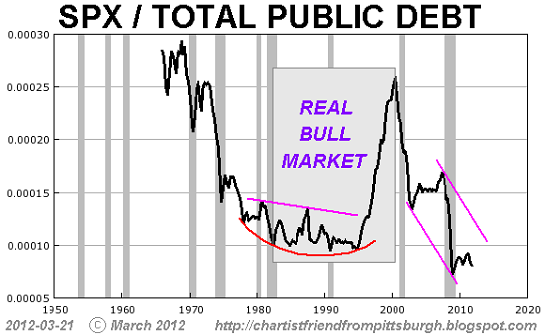
"In only three more years you're talking $20 trillion in public debt for the USA and a GDP going nowhere fast. And what does that look like in terms of the S&P 500? Courtesy of frequent contributor Chartist Friend from Pittsburgh, here is the SPX charted against total public debt. You'll notice it's crashing:


What this chart reflects is another aspect of the death spiral I described yesterday in The One Chart That Says It All: when depreciation outstrips new investment, then productivity, income and profit all decline. As interest on skyrocketing debt rises, then more income must be diverted to service debt, leaving less for new investment. That sets up a positive feedback loop, i.e. death spiral.

Here's how rising Federal debt creates a death spiral in the economy. As Federal debt skyrockets, the cost of debt service rises, even at super-low rates of interest. That means taxes must rise, because no constituency will allow its share of the Federal budget to decline by more than a symbolic amount. Higher taxes means there will be less money available for new investment, and the enormous sums of Federal debt that have to be sold crowds out other investment.

Interest rates have been manipulated lower for a few years via the Fed buying Treasuries with freshly printed money and a perceived "flight to safety," but eventually the Treasury will have to compete for investors' cash, and rates will rise.

The Federal government already borrows more per year than most country's gross national product: about $1.5 trillion a year. You can look it up here: Public Debt of the U.S. That's roughly 10% of the U.S. GDP, added to public debt each and every year.

Public debt on March 21, 2008, four years ago, was $9.39 trillion. Today it is $15.57 trillion. The difference is $6.18 trillion. Divide by four and voila, $1.5 trillion has been added to the debt annually.

Ignoring the politicos' shuck and jive about "balancing the budget" as tiresome political theater, let's multiply 3 X $1.5 trillion = $4.5 trillion, and add that to $15.57 trillion: in three years, Public Debt will top $20 trillion, on the way to $30 trillion..."

at http://www.zerohedge.com/news/guest-post-about-20-trillion-public-debt