Showing posts with label unemployment. Show all posts

Thursday, April 19, 2012

Leeb: QE3 Is Now 80% - 90% & I’m Going All-In Gold If It Dips

"With the release of the jobless claims number, the Dow at roughly 13,000 and gold near $1,650, today King World News interviewed acclaimed money manager Stephen Leeb, Chairman & Chief Investment Officer of Leeb Capital Management. Leeb surprised KWN when he mentioned if there is a break in the gold price, he is investing almost everything he has into gold and even some juniors. But first, when asked about the latest jobless claims number, Leeb responded, “388,000 is close to 400,000 and 400,000 is a number normally associated with a recession. We had about two or three months where all of the economic statistics were on the plus side, positive surprises.”

Stephen Leeb continues:
“Now, all of the sudden yesterday’s report on manufacturing and today, this is a standout negative surprise. This is exactly what Bernanke has been saying, that this economy is not growing enough to generate jobs and reduce unemployment. The reason gold got a bid this morning is because this 388,000 (number) brought us much closer to QE3. 
You cannot sustain the US economy with 8%, 8.5% unemployment. And we’re getting suggestions right now that we may have seen the best of the good news. That’s bad news for the people out there, but it is pretty good news for gold..."

Monday, April 16, 2012

Municipal Bankruptcy Crisis in U.S. to Have Dire National Consequences! Here’s Why – and How

"The plight of municipalities in the U.S., and their struggles under the weight of enormous pension budget deficits, are reaching the critical phase [with] many municipalities [now]contemplating bankruptcy. [That, in turn, is causing]… municipalities [to eliminate jobs (150,000 - 175,000 in 2012) providing significant headwinds to jobs growth nationally [which, in turn, will adversely affect] economic growth…[causing even] more municipalities to declare bankruptcy and [their] states, in turn, run to the Federal government for help..."

at http://www.munknee.com/2012/04/municipal-bankruptcy-crisis-in-u-s-to-have-dire-national-consequences-heres-why-and-how/

Sunday, April 15, 2012

Percent Job Losses: Great Recession and Great Depression

"The causes of the Great Recession were similar to the Great Depression - as opposed to most post war recessions that were caused by Fed tightening to slow inflation - and I'm frequently asked if we could compare the percent job losses during the two periods. Unfortunately there is very little data for the Great Depression.

Back in February I posted a graph based on some rough annual data.

On Friday, Treasury released a slide deck titled Financial Crisis Response In Charts. One of the charts shows the percentage jobs lost in the current recession compared to the Great Depression.

Percent Job Losses recent recession vs. Great DepressionClick on graph for larger image.

This graph compares the job losses from the start of the employment recession, in percentage terms for the Great Depression, the 2007 recession, and the average for several recent recession following financial crisis.

Although the 2007 recession is much worse than any other post-war recession, the employment impact was much less than during the Depression. Note the second dip during the Depression - that was in 1937 and the result of austerity measures."


at http://www.calculatedriskblog.com/2012/04/percent-job-losses-great-recession-and.html?utm_source=feedburner&utm_medium=feed&utm_campaign=Feed%3A+CalculatedRisk+%28Calculated+Risk%29

Tuesday, April 10, 2012

Inconsistencies in Spain's Budget Suggest Deficit will be 7% not 5.3%; Andalucia Regional Government Will Not Agree to Deficit Targets; Only 26% Trust Prime Minister to Overcome Crisis

"Courtesy of Google translate, please consider The inconsistencies of the State Budget for 2012
Much is written these days about the budget submitted by the Government for 2012, which proposes that the deficit be lowered to 5.3% of GDP. In this article we focus not on a comprehensive analysis of these items but in both revenue and expenditure forecasts which seem less realistic.

The first of these items is to transfer the SPEE (State Employment Service, former INEM). The government budgeted a reduction of 15.6% (2,464,000), arguing that many are unemployed benefits are ending.

Since the Government is assuming that unemployment will increase this year over 600,000 people, there is no reason for us to see a turnaround, quite the contrary. In view of the numbers a reasonable assumption would be a 10% increase in unemployment benefits starting in 2012. This means a delay of nearly 4,500 million from the budget, ie 0.4% of GDP..."
at  http://globaleconomicanalysis.blogspot.com/2012/04/inconsistencies-in-spains-budget.html?utm_source=feedburner&utm_medium=feed&utm_campaign=Feed%3A+MishsGlobalEconomicTrendAnalysis+%28Mish%27s+Global+Economic+Trend+Analysis%29

The Shocking Truth About Unemployment In America In One Chart

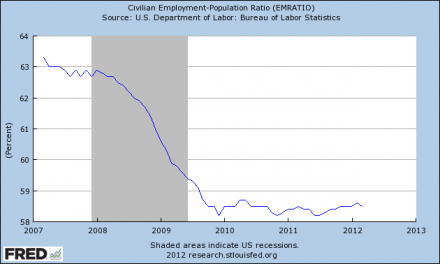
"The mainstream media is not telling you the truth about unemployment in the United States. The percentage of working age Americans that are employed is not increasing. In March 2010, 58.5 percent of all working age Americans had a job. In March 2012, 58.5 percent of all working age Americans had a job. So if the employment rate is exactly the same as it was two years ago, then how in the world can the Obama administration claim that things have gotten significantly better since then? According to the Bureau of Labor Statistics, the official unemployment rate in the United States was 9.8 percent in March 2010 and it declined to 8.2 percent in March 2012. So how is this possible if the percentage of working age Americans that have jobs hasn't moved? Well, what they do is they claim that there are millions upon millions of Americans that have "left the labor force". In other words, they claim that there are millions upon millions of unemployed Americans that don't want jobs anymore. Of course that is a total farce, but the mainstream media and most Americans are buying it. They actually believe that the unemployment rate is going down. But the truth is that the unemployment crisis in America has not subsided. In fact, we are pretty much exactly where we were two years ago, and things are about to get a whole lot worse.
If you want to know the shocking truth about unemployment in America, all you need to do is to look at one chart. The chart posted below shows the change in the employment-population ratio over the past few years. What the employment-population ratio measures is the percentage of working age Americans that actually have jobs. As you can see, it fell dramatically during 2008 and 2009, and since then it has been hovering between 58 and 59 percent...."


at http://theeconomiccollapseblog.com/archives/the-shocking-truth-about-unemployment-in-america-in-one-chart

Monday, April 9, 2012

MARC FABER: This Is Just The Beginning

"Stocks are off of their highs.
Marc Faber, publisher of the Gloom Boom & Doom Report, thinks they'll go down a lot more before they start heading up again.
In an interview with CNBC this past weekend, Faber said that last Friday's disappointing jobs report only affirms his opinion that the U.S. economy remains anemic.
And he thinks stocks are headed for a correction or even a bear market, which translates to a sell-off of at least 10 to 20 percent..."

at http://www.businessinsider.com/marc-faber-correction-bear-market-2012-4#ixzz1rZZRx54N

John Williams - Unemployment Rate at a Staggering 22.2%

"John Williams, of Shadowstats, notes that manipulated government statistics are not changing the fact that the true SGS Unemployment Measure now sits at a staggering 22.2%. Williams also demonstrates that despite the hype from Wall Street about a recovery, parts of the economy remain collapsed. Here is what Williams had to say about the situation: Adding the SGS estimate of excluded long-term discouraged workers back into the total unemployed and labor force, unemployment—more in line with common experience as estimated by the SGS-Alternate Unemployment Measure—notched lower to 22.2% in March from 22.4% in February.

at http://kingworldnews.com/kingworldnews/KWN_DailyWeb/Entries/2012/4/9_John_Williams_-_Unemployment_Rate_at_a_Staggering_22.2.html

Sunday, April 8, 2012

Save Time & Stay Informed: Read These 8 `Speak for Themselves` Economic Headlines From Around the World

"The 8 headlines below have been personally filtered this morning from over 1,200 articles canvassing economic and resource news. Reading these headlines will keep you better informed, and will save you time. If you are so inclined you can read the full articles using the links provided.

1. Americans brace for next foreclosure wave
  • Overview: The prospective state of the U.S. Residential Housing Foreclosures – which is generally seen as ‘negative news’.
  • Source: Reuters, Nick Carey, April 5, 2012.
  • Reading time: 5 minutes.
2. 19 Signs Of Very Serious Economic Trouble On The Horizon
  • Overview: Reports…on some rather shocking economic statistics.
  • Source: The Economic Collapse Blog, April 6, 2012.
  • Reading time: 4 minutes.
3. (U.S.) Nonfarm Payroll +120,000, Unemployment Rate Fell .1 to 8.2%, Record 87,897 “Not in Labor Force”
  • Overview: Summary of U.S. Labor Market suggesting that…the drop in the unemployment rate over the past two years is nothing but a statistical mirage…that things are much worse than the reported numbers indicate.
  • Source: Mish’s Global Economic Trend Analysis, Mike Shedlock, April 6, 2012.
  • Reading time: 5 minutes..."
at http://www.munknee.com/2012/04/save-time-stay-informed-read-these-8-speak-for-themselves-economic-headlines-from-around-the-world/

Saturday, April 7, 2012

Spain: The Ultimate Doomsday Presentation

"In summary, here are Carmel's five reasons why Spain's problems are worse than the market anticipates:

1. Spain’s national debt is 50% greater than the headline numbers

Spain’s debt-to-GDP balloons from 60% to 90% of GDP with regional and other debts

2. Spain’s housing prices will fall by an additional 35%

Spain built one house for every additional person added to the population during the past two decades; the fall will decrease GDP by ~2% each of the next two years

3. Spain has “zombie” banks with massive loans to developers and to homeowners

Banks have not begun to realize losses and are vastly undercapitalized

4. Spain’s economy has not stabilized and will continue to deteriorate

Spain has the highest unemployment in the developed world, one of the highest overall debt loads, and the most uncompetitive labor market in Europe

5. The EU will not have the firepower or political will to bail out Spain

Rescue fund headline numbers are misleading and count capital that is not yet committed

And here are the problems that will manifest themselves over the next 12 months:
  • Spain’s true debt burden will pass the 90% “tipping point” identified by Rogoff and Reinhart
  • Housing prices will fall further and faster than anticipated (consensus is 15%; CAM estimate is 35%)
  • Banks underestimate the residential real estate loan defaults (consensus estimate is 2.8% vs. CAM estimate of 11%)
  • Expected housing price depreciation and loan defaults will deepen Spain’s recession (additional 2% contraction in 2012 and 2013)
  • Spain will need to refinance €186.1 Billion in 2012 alone..."
at http://www.zerohedge.com/news/spain-ultimate-doomsday-presentation

READ MORE

Friday, April 6, 2012

El-Erian On The Bad Jobs Number: 'THE IMPLICATIONS GO BEYOND ECONOMICS'

"PIMCO CEO Mohamed El-Erian is shaken by today's disastrous jobs report.
Writing on FT.com, El-Erian listed off the disappointing metrics of the report, but he warns of much worse.
These disappointments partly reflect changing seasonal factors, including the prior impact of this winter’s unusually mild weather. But there is something much larger in play, and the implications go beyond economics; they influence key elements of the political narrative for the upcoming presidential and congressional elections.
The report demonstrates that firms "lack conviction" to hire for "expected future business."
Why? Uncertainty about everything, writes El-Erian:
American consumers, as a group, still carry too much debt and have to cope with higher oil prices. The prospects for exports, which have grown markedly, are gradually dimming now that the rest of the world is slowing. Meanwhile, policymakers have yet to find a way to deal properly with a year-end fiscal cliff, the result of Washington’s repeated inability to design coherent fiscal policy.
This demand uncertainty compounds worrisome structural impediments to growth.
His evidence that we already face structural problems: 5 million long-term unemployed; 9-month average time out of work; 25% unemployment for 16-19 year olds; and 12.6% unemployment for those without high school degrees..."

at http://www.businessinsider.com/el-erian-jobs-miss-2012-4?utm_source=feedburner&utm_medium=feed&utm_campaign=Feed%3A+clusterstock+%28ClusterStock%29#ixzz1rIEleWaC

READ MORE

51 Months After The Start Of The Recession, Here Is The Report Card

"Recovery? What Recovery? 4 years after central banks have progressively injected over $7 trillion in liquidity into the global markets (and thus, by Fed logic, the economy), and who knows how many trillion in fiscal aid has been misallocated, to halt the Second Great Depression which officially started in December 2007, the US "recovery" is the weakest in modern US history! How many more trillions will have to be printed (and monetized) before the central planners realize that fighting mean reversion by using debt to defeat recore debt, just doesnt't work? Our guess - lots.

Incidentally, the US has now generated 3 million jobs since the trough of the recession in September 2010, until which point it had previously lost 8 million. Unfortunately, since the real labor force has grown by 4.6 million over the same period, or at the conventionally accepeted 90,000 labor pool entrants per month for 51 months, despite what the BLS may say, because America is after all growing, this means that the Obama administration has created a negative 1.6 million jobs net of demographics, which in turn have cost the US a modest $5.1 trillion in new debt, or an even modest $3.1 million in debt for every job lost..."

Chart 1 - the current "recovery" in the context of all previous ones:


Chart 2 - Min, Max and Average... and now


at http://www.zerohedge.com/news/51-months-after-start-recession-here-report-card

READ MORE

19 Signs Of Very Serious Economic Trouble On The Horizon

"The following are 19 signs of very serious economic trouble on the horizon....

#1 According to one new survey, approximately one-third of all Americans are not paying their bills on time at this point.

#2 The U.S. housing industry is bracing for another huge wave of foreclosures in 2012. The following is from a recent Reuters article....

"We are right back where we were two years ago. I would put money on 2012 being a bigger year for foreclosures than 2010," said Mark Seifert, executive director of Empowering & Strengthening Ohio's People (ESOP), a counseling group with 10 offices in Ohio.

#3 The Citigroup Economic Surprise Index, a key indicator watched by many economists, is on the verge of heading into negative territory.

#4 We are supposed to be in the middle of an economic recovery in the United States, but bad news just keeps pouring in from major companies. For example, Yahoo is firing thousands of workers and Best Buy is closing dozens of stores.

#5 Richard Russell says that the "big money" is starting to quietly exit from the financial markets....

"My guess is that this is the big money that has been holding off as long as it decently can -- and then dumping their goods just before the close. I don't think the big money likes this market, and I think they have been slowly exiting this market, as quietly as they can."

#6 Goldman Sachs is projecting that the S&P 500 will fall by about 11 percent by the end of 2012..."

at http://theeconomiccollapseblog.com/archives/19-signs-of-very-serious-economic-trouble-on-the-horizon

READ MORE

Sunday, April 1, 2012

MAULDIN: The Biggest Thing That Matters Right Now Is Spain

"Last Monday I was in Paris and was asked to do a spot on CNBC London. I arrived at the studios an hour early due to a misunderstanding of the time zones, so while trying to catch up on the news I listened to CNBC. I had just written about Spain in last week's letter and guessed that was what they wanted to talk to me about, but for the full hour before I got on it seemed like every guest wanted to talk about Spain. When I had my turn and indeed got the Spain question, I smiled and noted that we were now in a period when it would be "All Spain All the Time," for at least the next year. I should have noted that there would be brief interruptions where we glanced at Portugal and perhaps Ireland, but the real focus would be on Spain.
I fully intended to write about something other than Europe this week, but the events of the last 24 hours compel me to once again look "across the pond" at the problems that not only plague Europe but will be a drag on world growth as well, as Europe goes through its continued painful adjustment as a consequence of trying to adopt a single currency. Since Spain is going to be on the front page for some time, it will be useful to look at some of the problems it is facing, to put it all into context. And what I heard while in Europe in private meetings is troubling.

All Spain All the Time

Spain is in a recession, though only down an estimated 1.7% in 2012, if things go well. Unemployment is at 23%, which is higher than Greece for the latest Greek data that I can find. But more than half of young Spaniards (over 51%) are out of work, creating a lost generation that has been hardest hit by Spain's economic woes. The total number of unemployed has climbed above five million, and Spanish under-25 unemployment has nearly tripled, from 18% just four years ago..."

at http://www.businessinsider.com/mauldin-the-biggest-thing-that-matters-right-now-is-spain-2012-3#ixzz1qnMxD4LG

Read more

Monday, March 19, 2012

GOLDMAN: 3 Reasons Why QE3 Is Still Coming

"This research note from Goldman’s Jan Hatzius has been making the rounds. In it he provides the three reasons why he believes QE3 is still on the table. He says:
“1. The improvement might not last.
With real GDP growth tracking just 2% in the first quarter and signs that at least some of the recent strength is probably due to the unusual warm weather and perhaps some seasonal adjustment distortions, question marks still surround the true pace of activity growth. In addition, there are still several actual or potential “headwinds” for growth, including a reduced boost from inventory accumulation, the recent increase in oil and gasoline prices, continued risks from the crisis in Europe, and the specter of fiscal retrenchment after the presidential election.
2. Even if the improvement does last, faster growth would be desirable to push down the unemployment rate more quickly.
Fed officials believe that the level of economic activity and employment is still far below potential. This means a large number of individuals are involuntarily unemployed, which not only causes hardship in the near term but may also translate into higher structural unemployment in the long term…This creates an incentive to find policies that speed up the return to full employment.
3. Not easing might be equivalent to tightening.
At a minimum, the bond market currently discounts some probability of QE3. This has kept financial conditions easier than they otherwise would have been, which has presumably supported economic activity. A decision not to ratify expectations of QE3 could therefore result in a tightening of financial conditions.”

at http://www.businessinsider.com/goldman-3-reasons-why-qe3-is-still-coming-2012-3#ixzz1pZlXCqvv

Friday, March 16, 2012

Collapse Coming–Not Recovery

"According to economist John Williams of Shadowstats.com, the latest good news about job creation is distorted with what he calls “massive seasonal adjustments.” The latest Shadowstats.com report, last Friday, said, “With heavy warping of the seasonal-adjustment process from the effects of the extreme nature of the current downturn, the resulting employment gain and unemployment rate level remain of questionable quality and significance.” If unemployment were calculated the way BLS did it in 1994 or earlier, the true unemployment rate would top 22% according to Shadowstats.com. Williams also says, “The outlook for the broad economy remains bleak, despite relatively upbeat February payroll data. Bank lending remains impaired, while household income has taken a new hit, as indicated in recent reporting. Separately . . . annual and monthly growth in the broad money supply appears to be stalling, again. That likely is a further indication of mounting difficulties in the systemic-solvency crisis.” (Click here to go to the Shadowstats.com home page.)
“Mounting difficulties in the systemic-solvency crisis” means, in reality, it is more likely financial collapse is coming—not recovery. Maybe that’s why the Federal Reserve recently announced it is going to start another round of money printing because the economy is teetering on an abyss. Marketwatch.com reported just last week, “Federal Reserve officials are considering a new type of quantitative easing that will attempt to boost the economy without accelerating inflation, according to a report published Wednesday.” (Click here for the complete Marketwatch.com story.) If the economy was in a real “recovery,” why would the Fed want to “boost the economy”? The Fed also announced at the end of January it would hold a key interest rate at 0% through 2014. If the “breadth and strength of the economic recovery” was so powerful, wouldn’t the Fed be hiking interest rates? Of course it would. The fact it is keeping them at zero for years and starting a new round of money printing is signaling the economy is in trouble, not in a so-called “recovery.”
Even near record low interest rates are not helping the morbid housing market to recover. According to the latest Case-Shiller report, home prices were down nearly 4% at the end of 2011. What kind of a recovery features near record low interest rates and falling home prices? Also, millions of empty houses are sitting on the books of the banks, and millions more are headed for foreclosure. Shouldn’t home inventory be shrinking in a real “recovery”? It is not, and that’s a fact!
Finally, if there really was a recovery, the government would not be hitting record deficits month after month. The deficit would shrink as the economy got better wouldn’t it? (Think Clinton era.) Instead, the Federal deficit is exploding! The Washington Times reported, just last week, “The federal government recorded its worst monthly deficit in history in February, according to a preliminary report Wednesday from the Congressional Budget Office that said the deficit in fiscal year 2012 is already more than half a trillion dollars. . . . The nonpartisan agency projected the government will run a deficit of $229 billion in February, the highest monthly figure ever.” (Click here for the complete report from the Washington Times.) That means the government spent nearly $8 billion more than it took in each and every day of last month (29 days). This is not a sign of economic “strength” but of tremendous weakness.
You cannot print your way to prosperity, but it can pave the way to an economic collapse."

at http://usawatchdog.com/collapse-coming-not-recovery/

Thursday, June 17, 2010

Bad Economic News

"Just consider some of the most recent economic news....
*The number of U.S. home foreclosures set a record for the second consecutive month in May. How can the U.S. housing industry be recovering when the number of Americans being foreclosed on continues to set all-time records?
*As of March, U.S. banks had an inventory of approximately 1.1 million foreclosed homes, up 20 percent from a year ago. Instead of working their way through the huge backlog of unsold homes, U.S. banks continue to pile up a massive inventory of foreclosed homes at a staggering pace.
*According to figures from the U.S. Commerce Department, housing starts in the United States fell 10 percent in May, the biggest decline since March 2009. The data also revealed that single-family home starts suffered the biggest drop since 1991. There is already a massive glut of unsold homes on the market, so builders simply do not think it is profitable to build many new homes right now.
*Officials now tell us that the cost of "fixing" Fannie Mae and Freddie Mac, the government-backed mortgage companies that last year bought or guaranteed the vast majority of all U.S. home loans, will be at least $160 billion and could grow as high as $1 trillion. The twin pillars of the U.S. mortgage industry have become financial black holes that the U.S. government endlessly pours massive amounts of cash into. That is not a good sign.
*Fannie Mae and Freddie Mac are to be delisted from the New York Stock Exchange because their stock prices have been trading under $1 per share for more than 30 trading days. The truth is that Fannie Mae and Freddie Mac would have completely imploded by now if the U.S. government had not decided to step in and bail them out.
*The average duration of unemployment in the United States has risen to an all-time high. Not only are a ton of Americans out of work, they can't find work for a very, very long time once they are unemployed.
*For Americans younger than 25 years of age, the unemployment rate is 18.8%. But even those young Americans that can find employment often find themselves working in very low paying service jobs.
*Federal Reserve Chairman Ben Bernanke says that the U.S. unemployment rate is likely to stay "high for a while". Considering how badly Bernanke has been doing his job, it would be really nice if we could add just one more person to the unemployment rolls.
*According to one new study, approximately 21 percent of children in the United States are living below the poverty line in 2010 - the highest rate in 20 years. There are hundreds of thousands of American children on the streets each night, and yet we continue to insist that we are the greatest country in the world.
*For the first time in U.S. history, more than 40 million Americans are on food stamps, and the U.S. Department of Agriculture projects that number will go up to 43 million Americans in 2011. How many tens of millions of Americans have to be on food stamps before we officially say that we are in a depression
"*According to the Wall Street Journal, the debates have begun inside the Fed about what it should do in the event of a "double dip" recession. If they are already debating what to do during the next economic downturn that means it is probably a foregone conclusion.
*If you were alive when Christ was born and spent one million dollars every single day from then until now, you still would not have spent one trillion dollars by now. But somehow the U.S. government is now over 13 trillion dollars in debt. According to a U.S. Treasury Department report to Congress, the U.S. national debt will top $13.6 trillion this year and climb to an estimated $19.6 trillion by 2015.
*It is being projected that the U.S. national debt will grow to surpass our gross domestic product in 2012. Needless to say, that is a really, really bad sign.
*The total of all government, corporate and consumer debt in the United States is now equal to 360 percent of GDP. At no point during the Great Depression did we ever even come close to such a figure.
But things may be even worse in Europe right now. Unfortunately for the U.S., when Europe experiences an economic collapse it will devastate the American economy as well.
The economic news coming out of Europe lately has been extremely alarming....
*George Soros says that a European recession next year is "almost inevitable". Considering how much access George Soros has to inside information, the fact that he is so pessimistic about Europe is a very troubling thing indeed.
*A report by the Bank for International Settlements says that the debt crisis hitting southern Europe resembles the 2007 subprime mortgage crisis. Is history about to repeat itself?
*Moody's has downgraded Greece government bond ratings into junk territory, citing the risks inherent in the rescue package that the rest of the eurozone has put together for them. Soon Spain, Portugal, Italy, Ireland, Romania and a number of other European nations could have their debt downgraded as well.
*The U.K.'s new Office for Budget Responsibility has announced that the U.K. economy was more damaged by the recent financial crisis than previously admitted, and that it may never fully recover. But the same could be said for many other nations across the world as well.
*21.5% of all working-age people in the U.K. do not have a job. It seems like almost every country has a shortage of jobs these days.
*New U.K. Prime Minister David Cameron is warning that Britain's "whole way of life" is about to be significantly disrupted for years by the most drastic public spending cuts in a generation. In fact, severe austerity measures being implemented all across Europe could make this one of the most "interesting" European summers in ages.
*Spanish banks are borrowing record amounts of money from the European Central Bank as Spain's financial institutions are finding it increasingly difficult to acquire funds in international capital markets. But the truth is that it isn't just Spanish banks that are facing a liquidity squeeze - the entire world is heading for a massive credit crunch."

at http://theeconomiccollapseblog.com/archives/bad-economic-news

Philly Fed's Weak Economic Report

"Bloomberg details:

The Federal Reserve Bank of Philadelphia’s general economic index slumped to 8 in June from 21.4 the previous month. Readings above zero signal growth.
Economists forecast the index would fall to 20, according to the median of 58 projections in a Bloomberg News survey. Estimates ranged from 10 to 24.
The figures follow a report from the Labor Department today that showed consumer prices fell in May for a second month. The Labor Department also said jobless claims rose by 12,000 to 472,000 last week.

That employment report is concerning, especially when taken in combination with the Philly Fed report's shift of employment (number of employees / average workweek) to negative territory."
 
at http://econompicdata.blogspot.com/2010/06/philly-feds-weak-economic-report.html

Tuesday, June 15, 2010

9 Reasons Why Spain Is A Dead Economy Walking

"The following are 9 reasons why Spain is a dead economy walking....
#1) Even before this most recent crisis, unemploment in Spain was approaching Great Depression levels. Spain now has the highest unemployment rate in the entire European Union. More than 20 percent of working age Spaniards were unemployed during the first quarter of 2010. If people aren't working they can't pay taxes and they can't provide for their families.
#2) In an effort to stimulate the economy, Spain's socialist government has been spending unprecedented amounts of money and that skyrocketed the government budget deficit to a stunning 11.4 percent of GDP in 2009. That is completely unsustainable by any definition.
#3) The total of all public and private debt in Spain has now reached 270 percent of GDP.
#4) The Spanish government has accumulated way more debt than it can possibly handle, and this has forced two international ratings agencies, Fitch and Standard & Poor’s, to lower Spain’s long-term sovereign credit rating. These downgrades are making it much more expensive for Spain to finance its debt at a time when they simply can't afford to pay more interest on their debt.
#5) There are 1.6 million unsold properties in Spain. That is six times the level per capita in the United States. Considering how bad the U.S. real estate market is, that statistic is incredibly alarming.
#6) The new "green economy" in Spain has been a total flop. Socialist leaders promised that implementing hardcore restrictions on carbon emissions and forcing the nation over to a "green economy" would result in a flood of "green jobs". But that simply did not happen. In fact, a leaked internal assessment produced by the government of Spain reveals that the "green economy" has been an absolute economic nightmare for that nation. Energy prices have skyrocketed in Spain and the new "green economy" in that nation has actually lost more than two jobs for every job that it has created. But Spain so far seems unwilling to undo all of the crazy regulations that they have implemented.
#7) Spain's national debt is so onerous that they are now caught in a debt spiral where anything they do will harm the economy. If they cut government expenditures in an effort to get debt under control it will devastate economic growth and crush badly needed tax revenues. But if the Spanish government keeps borrowing money their credit rating will continue to decline and they will almost certainly default. The truth is that the Spanish government is caught in a "no win" situation.
#8) But even now the IMF is projecting that the Spanish economy is going nowhere fast. The International Monetary Fund says there will be no positive GDP growth in Spain until 2011, at which point it will still be below one percent. As bleak as that forecast is, many analysts believe that it is way too optimistic considering the fact that Spain's economy declined by about 3.6 percent in 2009 and things are rapidly getting worse.
#9) The Spanish population has gotten used to socialist handouts and they are not going to accept public sector pay cuts, budget cuts to social programs and hefty tax increases easily. In fact, there is likely to be some very serious social unrest before all of this is said and done. On May 21st, thousands of public sector workers took to the streets of Spain to protest the government’s austerity plan. But that was only an appetizer. Spain's two main unions are calling for a major one day general strike to protest the government's planned reforms of the country's labor market. The truth is that financial shock therapy does not go down very well in highly socialized nations such as Greece and Spain. In fact, the austerity measures that Spain has been pressured to implement by the IMF have proven so unpopular that many are now projecting that Spain's socialist government will be forced to call early elections."

at http://theeconomiccollapseblog.com/archives/9-reasons-why-spain-is-a-dead-economy-walking

Sunday, June 13, 2010

Investors Face Long-term Structural Changes of Lower Growth, Higher Volatility and Unemployment

"...What do we get when we put the three structural breaks together? Higher volatility and lower trend growth produce more frequent recessions. More frequent recessions and stubbornly high unemployment rates mean that recoveries will not be long-lasting enough to put everyone back to work who would like to work. This in large part explains why high unemployment is currently so problematic.
What are the investment implications for the Muddle Through Economy? Investors will have to adjust to this new reality. Reducing leverage is one way. Another is to reduce the average holding period of investments. Investors will have to become more nimble. This in itself may add to market volatility.
For longer-term investors, this change of paradigm will mean achieving consistent returns is even more difficult. However, investors with a shorter-term, more tactical outlook may find these new, more volatile conditions a source of great opportunities.
The End Game
John Mauldin and I are writing a book called The End Game, about how government policies around the world will likely play out.
The End Game will be about the structural changes affecting the US and many other developed economies and how this impacts you, the reader. Currently the world is caught in a tug of war between deflation and inflation. The global economy faces powerful deflationary forces, which have induced equally powerful responses from governments around the world. Governments have ratcheted up the creation of monetary reserves and increased public spending across the board. Much of the spending is unsustainable, and the monetary reserves may eventually become a problem, resulting in inflation. The outcomes are binary, and they are not good.
Policymakers have not even begun to deal with the problems. As Chairman Bernanke has pointed out, "A variety of projections that extrapolate current policies and make plausible assumptions about the future evolution of the economy, show a structural budget gap that is both large relative to the size of the economy and increasing over time." He stated that "the federal budget appears to be on an unsustainable path." Those are strong words for a Fed chairman. I hope Congress is listening.
In the current economic environment, there are bad choices and worse ones. We hope governments around the world will know how to choose wisely..."

at http://www.marketoracle.co.uk/Article20249.html

Saturday, June 12, 2010

After Government Economic Stimulus

"There is perhaps no better example of the destructive nature of government intervention than the current housing and retail goods markets. For the past three years a spend-happy Congress lavished these areas with stimulus spending, tax credits, and other palliatives all aimed at papering over the structural defects in these markets. In the case of housing, the problem was years of easy money, sky-high prices, and zero-standards lending.

In the case of retail goods, it was years of abuse of various types of credit to expand a spending bubble and increased reliance on foreign products. However, Congress has now buttoned up – in fear for their political existence in many cases. The public is aware and fearful of debt for the first time in recent memory. Living in a post-stimulus world; even if it is only until the next Congress is seated will be interesting to say the least.
The Housing Market’s Freefall
While the actual damage to the housing market in the near term cannot be totally assessed until later this month, there are some hints in the rate at which purchase applications for mortgages have plunged.

During the past 4 weeks, purchase applications are down a whopping 35%. It is easy to see the spike at the end of April as the end of the tax credit lured May’s (and perhaps June’s too) sales back a month. The downward trend of new purchase applications has continued into June despite very low relative interest rates for home loans. These low rates boosted the Refinance portion of the index during May and remain low, the national average currently at 4.88% according to bankrate.com.

With an upcoming election, we will now likely get the first glimpse at the true state of the housing market. Granted there are still many programs in place at the Fannie/Freddie/FHA level that are encouraging purchases to varying degrees, but it is not likely that direct stimulus through tax credits will be used for at least the next few months. What is very disconcerting is that more than half of the purchasing blitz during March and April was done on the back of government mortgages. Much in the way the government nationalized the student loan business it is now similarly giving the heave ho to private lenders in the mortgage market. These actions virtually guarantee the perpetuation of the distortions currently seen in this critical area.

I had commented, perhaps cynically, to some friends back in 2005 that the housing bubble seemed to be little more than a giant property grab. With government now owning or guaranteeing the majority of mortgages (69 percent), it seems that very well could be the case. Unemployment is still high, decent paying jobs are difficult to come by, and people are still being laid off. Consumer debt burdens are causing the financial hardships endured by many to continue. Repossessions of houses just hit another all-time record high last month. When the government owns the mortgage and someone defaults, who gets the house? Some food for thought on a Friday afternoon."
 
at http://www.marketoracle.co.uk/Article20229.html