Showing posts with label recession. Show all posts

Thursday, April 19, 2012

Leeb: QE3 Is Now 80% - 90% & I’m Going All-In Gold If It Dips

"With the release of the jobless claims number, the Dow at roughly 13,000 and gold near $1,650, today King World News interviewed acclaimed money manager Stephen Leeb, Chairman & Chief Investment Officer of Leeb Capital Management. Leeb surprised KWN when he mentioned if there is a break in the gold price, he is investing almost everything he has into gold and even some juniors. But first, when asked about the latest jobless claims number, Leeb responded, “388,000 is close to 400,000 and 400,000 is a number normally associated with a recession. We had about two or three months where all of the economic statistics were on the plus side, positive surprises.”

Stephen Leeb continues:
“Now, all of the sudden yesterday’s report on manufacturing and today, this is a standout negative surprise. This is exactly what Bernanke has been saying, that this economy is not growing enough to generate jobs and reduce unemployment. The reason gold got a bid this morning is because this 388,000 (number) brought us much closer to QE3. 
You cannot sustain the US economy with 8%, 8.5% unemployment. And we’re getting suggestions right now that we may have seen the best of the good news. That’s bad news for the people out there, but it is pretty good news for gold..."

Monday, April 16, 2012

SUEZ CANAL TRAFFIC POINTS TO GLOBAL SLOW-DOWN

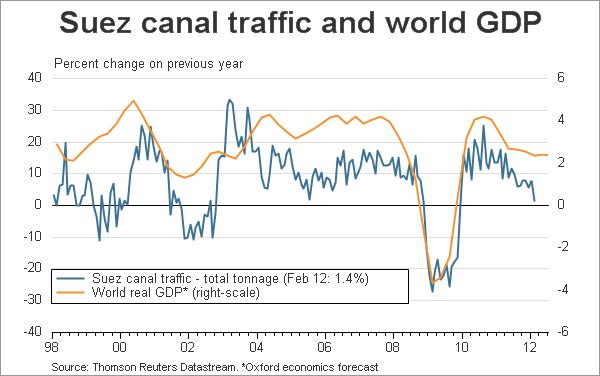
"Here’s an indicator I had never seen before. Reuters is highlighting the slow-down in Suez Canal traffic as a possible harbinger of stagnating global economic growth:
“As this week’s Chart of the Week indicates, traffic through the Suez Canal in Egypt – a key cargo transportation route – has nosedived in recent weeks and months. Currently, Suez traffic is only slightly better than flat compared to year earlier levels. Unsurprisingly, perhaps, the trends in global GDP growth tend to mirror those in traffic transiting the Suez canal; it is logical that trade volumes would flag during periods of contraction or sluggish growth, as is most vividly illustrated by the close correlation between the two indicators at the height of the financial crisis from late 2008 through 2009.”

at  http://pragcap.com/suez-canal-traffic-points-to-global-slow-down

Sunday, April 15, 2012

Roubini : Darker days ahead for The Eurozone as Recession sinks in

"Nouriel Roubini : “The trouble is that the eurozone has an austerity strategy but no growth strategy. And, without that, all it has is a recession strategy that makes austerity and reform self-defeating, because, if output continues to contract, deficit and debt ratios will continue to rise to unsustainable levels. Moreover, the social and political backlash eventually will become overwhelming.
That is why interest-rate spreads in the eurozone periphery are widening again now. The peripheral countries suffer from severe stock and flow imbalances. The stock imbalances include large and rising public and private debt as a share of GDP. The flow imbalances include a deepening recession, massive loss of external competitiveness, and the large external deficits that markets are now unwilling to finance.
Without a much easier monetary policy and a less front-loaded mode of fiscal austerity, the euro will not weaken, external competitiveness will not be restored, and the recession will deepen. And, without resumption of growth – not years down the line, but in 2012 – the stock and flow imbalances will become even more unsustainable. More eurozone countries will be forced to restructure their debts, and eventually some will decide to exit the monetary union.”
Read the entire piece at Project Syndicate >>>>>>>

at http://nourielroubini.blogspot.com/2012/04/roubini-darker-days-ahead-for-eurozone.html?utm_source=feedburner&utm_medium=feed&utm_campaign=Feed%3A+NourielRoubiniBlog+%28Nouriel+Roubini+Blog%29

Thursday, April 12, 2012

IS EUROPE’S RECESSION SPREADING BEYOND THE EUROZONE?

"When Sweden’s Q4 GDP fell 1.1% from the previous quarter, most analysts thought of it as a temporary blip. After all the Q4 GDP was still positive on a year-over-year basis.
Sweden GDP YOY (Bloomberg)

But the “temporary blip” out of Sweden has turned into something more ominous when the February industrial production numbers came out this morning. Here we are no longer talking about Q4 which was challenging for most major economies.
Reuters: Swedish industrial production suffered its sharpest fall since 2009 in February, jarring a reassuringly rosy outlook painted by other recent economic indicators and calling into question expectations the central bank will not take rates any lower.
Sweden Industrial Production YOY (Bloomberg)

Industrial orders have also turned sharply negative.
Sweden Industrial Orders YOY (Bloomberg)

Of all the European economies, Sweden was supposed to be fairly insulated from the Eurozone problems, particularly given its decent debt to GDP ratio of 37% and export oriented economy..."

at http://pragcap.com/is-europes-recession-spreading-beyond-the-eurozone

Wednesday, April 4, 2012

Eurozone Composite PMI® Signals Recession Says Markit; France in Renewed Decline, German Growth Weakens, Italy and Spain Contract Further

"In what should have been expected, but somehow wasn't, Eurozone weakness is across the board except for Ireland bucking the trend for now.

Markit says Eurozone Composite PMI® Signals New Recession in Eurozone
Key Points for March

  • Final Eurozone Composite Output Index: 49.1 (Flash 48.7, February 49.3)
  • Final Eurozone Services Business Activity Index: 49.2 (Flash 48.7, February 48.8)
  • France sees renewed decline, German growth..."


at  http://globaleconomicanalysis.blogspot.com/2012/04/eurozone-composite-pmi-signals.html?utm_source=feedburner&utm_medium=feed&utm_campaign=Feed%3A+MishsGlobalEconomicTrendAnalysis+%28Mish%27s+Global+Economic+Trend+Analysis%29

READ MORE

Tuesday, April 3, 2012

German Manufacturing PMI Back in Contraction, New Orders Plunge, Price Inflation Up

"As expected (by me anyway), the Markit/BME Germany Manufacturing PMI® shows Germany is back in contraction.
Weaker new order intakes lead to deteriorating manufacturing business conditions in March.

Key Points:

  • Output growth slows to only marginal pace
  • Sharpest fall in new work for three months
  • Cost inflation highest since July 2011..."
at  http://globaleconomicanalysis.blogspot.com/2012/04/german-manufacturing-pmi-back-in.html?utm_source=feedburner&utm_medium=feed&utm_campaign=Feed%3A+MishsGlobalEconomicTrendAnalysis+%28Mish%27s+Global+Economic+Trend+Analysis%29

READ MORE

Roubini : Without growth, the socio-political backlash will become overwhelming for some governments

"Nouriel Roubini : “There’s this vicious circle with the deficit that doing austerity makes the recession worse,” he said. “Without growth, the socio-political backlash will become overwhelming for some governments.” - in CNBC"

at http://nourielroubini.blogspot.com/2012/04/roubini-without-growth-socio-political.html?utm_source=feedburner&utm_medium=feed&utm_campaign=Feed%3A+NourielRoubiniBlog+%28Nouriel+Roubini+Blog%29

READ MORE

Pento - Global Recession, Monetary Madness & Gold

"Today Michael Pento chonicles the mounting problems that Europe is facing and stated that gold is ready to explode higher if the Fed engages in more “counterfeiting.” Pento, who founded Pento Portfolio Strategies, also writes exclusively for King World News about the fact that consumer debt is rising, while savings is tumbling. Here is what Pento had to say: “The mainstream media is busy promulgating the idea that the Great Recession is a fast-fading memory and that it’s now clear sailing for the global economy. But the true numbers belie that notion. One of the supposedly good news items being celebrated in the U.S. was found in the ISM Manufacturing Survey released this week. It increased to 53.4 in March, from a level of 52.4 in the prior month.”
Michael Pento continues:
“However, the somewhat better news on manufacturing came on the back of a U.S. consumer that has fully reverted to their borrowing and consuming ways. Spending increased by 0.8% in February, the most in seven months but incomes only increased by 0.2%. More importantly, real disposable income declined by 0.1%, which was the third such decrease in the last four months. As a consequence, the savings rate fell out of bed to 3.7% from 4.3%, which was the lowest level since August 2009.
Therefore, the small rebound in manufacturing and huge increase in spending by the consumer is ersatz and unsustainable in nature. The problem is that consumer debt has now started to increase once again, at a time when it desperately needs to contract.
The Europeans have taken a small step towards addressing their problems..."


Monday, April 2, 2012

CHART OF THE DAY: THE TRUTH ABOUT EUROPE

"The economy is getting worse.

We just got a big slew of PMI numbers, and a few things are clear in Europe.
  • The periphery is hurting badly. What countries like Spain, Italy, and Greece so desperately need is growth, and they're not getting any of it. This not only is bad from a societal standpoint (as the jobs picture gets worse and worse) but it makes sovereign debt dynamics worse, as the GDP part of debt-to-GDP shrinks.
  • Core is not doing so hot either. The French number showed a particularly steep drop. Germany has dropped below 50 as well.
  • Surprisingly, the only real "bright spot" was Ireland, which saw a big pickup in New Orders and exports. Somehow it continues to avoid the curse of the rest of the PIIGS.
This chart from Markit summarizes the situation up nicely, as it shows the core of Europe rapidly meeting the periphery in the recession zone.

PMI

at http://www.businessinsider.com/chart-of-the-day-european-pmi-numbers-2012-4?utm_source=feedburner&utm_medium=feed&utm_campaign=Feed%3A+businessinsider+%28Business+Insider%29#ixzz1qtGMOPOl

READ MORE

Sunday, April 1, 2012

MAULDIN: The Biggest Thing That Matters Right Now Is Spain

"Last Monday I was in Paris and was asked to do a spot on CNBC London. I arrived at the studios an hour early due to a misunderstanding of the time zones, so while trying to catch up on the news I listened to CNBC. I had just written about Spain in last week's letter and guessed that was what they wanted to talk to me about, but for the full hour before I got on it seemed like every guest wanted to talk about Spain. When I had my turn and indeed got the Spain question, I smiled and noted that we were now in a period when it would be "All Spain All the Time," for at least the next year. I should have noted that there would be brief interruptions where we glanced at Portugal and perhaps Ireland, but the real focus would be on Spain.
I fully intended to write about something other than Europe this week, but the events of the last 24 hours compel me to once again look "across the pond" at the problems that not only plague Europe but will be a drag on world growth as well, as Europe goes through its continued painful adjustment as a consequence of trying to adopt a single currency. Since Spain is going to be on the front page for some time, it will be useful to look at some of the problems it is facing, to put it all into context. And what I heard while in Europe in private meetings is troubling.

All Spain All the Time

Spain is in a recession, though only down an estimated 1.7% in 2012, if things go well. Unemployment is at 23%, which is higher than Greece for the latest Greek data that I can find. But more than half of young Spaniards (over 51%) are out of work, creating a lost generation that has been hardest hit by Spain's economic woes. The total number of unemployed has climbed above five million, and Spanish under-25 unemployment has nearly tripled, from 18% just four years ago..."

at http://www.businessinsider.com/mauldin-the-biggest-thing-that-matters-right-now-is-spain-2012-3#ixzz1qnMxD4LG

Read more

Friday, March 23, 2012

More austerity measures as Spain’s public debt soars

"Spain’s financial situation is deteriorating rapidly, with debt reaching an historic high of 68.5 percent of GDP during the last quarter of 2011. It has now entered its second recession since 2009.

“Spain seems to be the main risk in the near future for Europe,” said UBS AG chief European economist Stephane Deo.

Madrid is supposed to stick to targets agreed two years ago with the European Commission, the European Central Bank and International Monetary Fund to cut the deficit from 9.2 percent of GDP in 2010, to 4.4 percent this year and 3.0 percent by 2013. Last month, Prime Minister Mariano Rajoy declared the country would not be able to meet the 4.4 percent target and had “unilaterally” decided to change it to 5.8 percent. The European Commission agreed a revision was necessary, but insisted the target had to be 5.3 percent.

This means Spain will have to come up with more than €35 billion in savings to meet the new target on top of the €15 billion worth of tax rises and spending cuts already announced in December. Economy Minister Luis De Guindos has suggested that VAT may be raised next year and Finance Minister Cristobal Montoro, has estimated that to meet the new 5.3 percent goal the central government will have to reduce spending from 5.1 percent to 3.5 percent.

On top of this, forecasts predict that the Spanish economic output will fall by 1.7 percent this year. Exports decreased 1.6 percent from the previous three months, and consumer spending declined by an annual rate of 1.1 percent.

The real estate sector, upon which Spain has depended heavily over the past decade, continues to slump. The fourth quarter of 2011 saw the price of an average new home fall 8.5 percent compared to the previous year, while the price of used properties was down 13.7 percent..."

at http://www.wsws.org/articles/2012/mar2012/spai-m22.shtml

Thursday, March 22, 2012

"Eurozone Slides Back Into Recession" Says Markit PMI News Release; Sharp Decline in German Export Business; Misguided Decoupling Theories

"Inquiring minds are digging into details of the latest Eurozone releases. The Markit Flash Eurozone PMI® says Eurozone slides back into recession as output falls at stronger rate in March
Both manufacturing output and service sector activity contracted in March, showing the worst performances for three and four months respectively. However, in both cases, the rates of decline were only very modest.

Output rose in Germany, but the rate of growth slowed to a three-month low to show only a marginal gain. Output meanwhile fell slightly in France for the first time in four months, and dropped sharply again in the rest of the region.

  • Flash Eurozone PMI Composite Output Index at 48.7 (49.3 in February). 3-month low.
  • Flash Eurozone Services PMI Activity Index at 48.7 (48.8 in February). 4-month low.
  • Flash Eurozone Manufacturing PMI at 47.7 (49.0 in February). 3-month low.
  • Flash Eurozone Manufacturing PMI Output Index at 48.8 (50.3 in February). 3-month low..."

Eurozone PMI vs. GDP


at  http://globaleconomicanalysis.blogspot.com/2012/03/eurozone-slides-back-into-recession.html

Tuesday, March 20, 2012

Carmageddon: European New Car Sales Crash, Worst February in History

"Truth About Cars reports European New Car Sales Have Worst February Of The Millennium


The European new car market crashed in February. According to data released by the European manufacturers’ association ACEA, new car sales were down 9.7 percent in February. Two months into the year, car sales in the EU are down 8.3 percent from the same period a year earlier..."

at  http://globaleconomicanalysis.blogspot.com/2012/03/carmageddon-european-new-car-sales.html

Wednesday, March 14, 2012

Roubini: Attack on Iran Would Send Oil to $200, Spark Recession

"An attack on Iran would send oil prices as high as $200 a barrel and threaten to push the world back into recession, says New York University economist Nouriel Roubini.

Tensions have been building between the West and Tehran over the latter's nuclear ambitions, and concerns are brewing that Israel may be mulling an attack on Iran despite calls from the U.S. to give sanctions a chance.

"If there's an effect on the supply of oil and gas from the Gulf, and production and exports from Iran go for a while to zero, oil could go to $170, $180, $200 a barrel," Roubini tells Foreign Policy magazine.

"If you think about the last three major global recessions, there were all caused by a geopolitical shock in the Middle East that led to spike in oil prices," Roubini adds, referring to the Yom Kippur War in 1973 the Iranian revolution in 1979 and the 1990 Iraqi invasion of Kuwait, all of which contributed to global economic contractions.
Even if war is avoided, tensions alone are going to push up oil prices, which will take U.S. gasoline prices up with them and dampen the economy.

"I would not underestimate the effect of gasoline today, in a number of U.S. states, being already at $4.00 a gallon — and it could be so in many other states. Psychologically, once you're above the $4 mark, it has an impact on consumer confidence," Roubini says.

Prices rise during the U.S. summer anyway, when driving increases and refineries switch to pricier inputs.

"The higher those oil prices are, the higher the chance that has a negative effect on consumer confidence, on disposable income, and on the economy. And it's not just in the U.S. — the price of oil is very high in Europe and in many other parts of the world," Roubini says..."

at http://www.moneynews.com/StreetTalk/Roubini-Attack-Iran-Oil/2012/03/14/id/432485

Gas Prices and the European Recession

"Some media outlets have published gas prices in nations outside the U.S. to show the contrast to American prices, which are near record highs. A glance at these lists shows how much worse off many residents of Europe are compared to U.S. consumers, who have already started to strain under the weight of $3.80 per gallon of regular gas. And much of Europe is already in recession, which is not the case in America. Gas prices will cause the recessions throughout Europe to worsen..."

at http://247wallst.com/2012/03/13/gas-prices-and-the-european-recession/#ixzz1p4nlHrFc

Friday, June 18, 2010

ECRI GROWTH CONTINUES TO DECLINE

"The negative trend in the ECRI’s weekly leading index continued this week. The annual growth rate for their leading index declined to -5.7% for the week ending June 11th. This was down from -3.7% last week. This is just the second negative reading since the ECRI began calling for an economic recovery early in 2009. Lakshman Achuthan, ECRI’s managing director is not yet concerned about the decline in the leading index:
“Despite the WLI’s rapid drop over the last six weeks, its downturn has not been sustained enough to signal an imminent recession.”


Thursday, June 17, 2010

Bad Economic News

"Just consider some of the most recent economic news....
*The number of U.S. home foreclosures set a record for the second consecutive month in May. How can the U.S. housing industry be recovering when the number of Americans being foreclosed on continues to set all-time records?
*As of March, U.S. banks had an inventory of approximately 1.1 million foreclosed homes, up 20 percent from a year ago. Instead of working their way through the huge backlog of unsold homes, U.S. banks continue to pile up a massive inventory of foreclosed homes at a staggering pace.
*According to figures from the U.S. Commerce Department, housing starts in the United States fell 10 percent in May, the biggest decline since March 2009. The data also revealed that single-family home starts suffered the biggest drop since 1991. There is already a massive glut of unsold homes on the market, so builders simply do not think it is profitable to build many new homes right now.
*Officials now tell us that the cost of "fixing" Fannie Mae and Freddie Mac, the government-backed mortgage companies that last year bought or guaranteed the vast majority of all U.S. home loans, will be at least $160 billion and could grow as high as $1 trillion. The twin pillars of the U.S. mortgage industry have become financial black holes that the U.S. government endlessly pours massive amounts of cash into. That is not a good sign.
*Fannie Mae and Freddie Mac are to be delisted from the New York Stock Exchange because their stock prices have been trading under $1 per share for more than 30 trading days. The truth is that Fannie Mae and Freddie Mac would have completely imploded by now if the U.S. government had not decided to step in and bail them out.
*The average duration of unemployment in the United States has risen to an all-time high. Not only are a ton of Americans out of work, they can't find work for a very, very long time once they are unemployed.
*For Americans younger than 25 years of age, the unemployment rate is 18.8%. But even those young Americans that can find employment often find themselves working in very low paying service jobs.
*Federal Reserve Chairman Ben Bernanke says that the U.S. unemployment rate is likely to stay "high for a while". Considering how badly Bernanke has been doing his job, it would be really nice if we could add just one more person to the unemployment rolls.
*According to one new study, approximately 21 percent of children in the United States are living below the poverty line in 2010 - the highest rate in 20 years. There are hundreds of thousands of American children on the streets each night, and yet we continue to insist that we are the greatest country in the world.
*For the first time in U.S. history, more than 40 million Americans are on food stamps, and the U.S. Department of Agriculture projects that number will go up to 43 million Americans in 2011. How many tens of millions of Americans have to be on food stamps before we officially say that we are in a depression
"*According to the Wall Street Journal, the debates have begun inside the Fed about what it should do in the event of a "double dip" recession. If they are already debating what to do during the next economic downturn that means it is probably a foregone conclusion.
*If you were alive when Christ was born and spent one million dollars every single day from then until now, you still would not have spent one trillion dollars by now. But somehow the U.S. government is now over 13 trillion dollars in debt. According to a U.S. Treasury Department report to Congress, the U.S. national debt will top $13.6 trillion this year and climb to an estimated $19.6 trillion by 2015.
*It is being projected that the U.S. national debt will grow to surpass our gross domestic product in 2012. Needless to say, that is a really, really bad sign.
*The total of all government, corporate and consumer debt in the United States is now equal to 360 percent of GDP. At no point during the Great Depression did we ever even come close to such a figure.
But things may be even worse in Europe right now. Unfortunately for the U.S., when Europe experiences an economic collapse it will devastate the American economy as well.
The economic news coming out of Europe lately has been extremely alarming....
*George Soros says that a European recession next year is "almost inevitable". Considering how much access George Soros has to inside information, the fact that he is so pessimistic about Europe is a very troubling thing indeed.
*A report by the Bank for International Settlements says that the debt crisis hitting southern Europe resembles the 2007 subprime mortgage crisis. Is history about to repeat itself?
*Moody's has downgraded Greece government bond ratings into junk territory, citing the risks inherent in the rescue package that the rest of the eurozone has put together for them. Soon Spain, Portugal, Italy, Ireland, Romania and a number of other European nations could have their debt downgraded as well.
*The U.K.'s new Office for Budget Responsibility has announced that the U.K. economy was more damaged by the recent financial crisis than previously admitted, and that it may never fully recover. But the same could be said for many other nations across the world as well.
*21.5% of all working-age people in the U.K. do not have a job. It seems like almost every country has a shortage of jobs these days.
*New U.K. Prime Minister David Cameron is warning that Britain's "whole way of life" is about to be significantly disrupted for years by the most drastic public spending cuts in a generation. In fact, severe austerity measures being implemented all across Europe could make this one of the most "interesting" European summers in ages.
*Spanish banks are borrowing record amounts of money from the European Central Bank as Spain's financial institutions are finding it increasingly difficult to acquire funds in international capital markets. But the truth is that it isn't just Spanish banks that are facing a liquidity squeeze - the entire world is heading for a massive credit crunch."

at http://theeconomiccollapseblog.com/archives/bad-economic-news

Sunday, June 13, 2010

Investors Face Long-term Structural Changes of Lower Growth, Higher Volatility and Unemployment

"...What do we get when we put the three structural breaks together? Higher volatility and lower trend growth produce more frequent recessions. More frequent recessions and stubbornly high unemployment rates mean that recoveries will not be long-lasting enough to put everyone back to work who would like to work. This in large part explains why high unemployment is currently so problematic.
What are the investment implications for the Muddle Through Economy? Investors will have to adjust to this new reality. Reducing leverage is one way. Another is to reduce the average holding period of investments. Investors will have to become more nimble. This in itself may add to market volatility.
For longer-term investors, this change of paradigm will mean achieving consistent returns is even more difficult. However, investors with a shorter-term, more tactical outlook may find these new, more volatile conditions a source of great opportunities.
The End Game
John Mauldin and I are writing a book called The End Game, about how government policies around the world will likely play out.
The End Game will be about the structural changes affecting the US and many other developed economies and how this impacts you, the reader. Currently the world is caught in a tug of war between deflation and inflation. The global economy faces powerful deflationary forces, which have induced equally powerful responses from governments around the world. Governments have ratcheted up the creation of monetary reserves and increased public spending across the board. Much of the spending is unsustainable, and the monetary reserves may eventually become a problem, resulting in inflation. The outcomes are binary, and they are not good.
Policymakers have not even begun to deal with the problems. As Chairman Bernanke has pointed out, "A variety of projections that extrapolate current policies and make plausible assumptions about the future evolution of the economy, show a structural budget gap that is both large relative to the size of the economy and increasing over time." He stated that "the federal budget appears to be on an unsustainable path." Those are strong words for a Fed chairman. I hope Congress is listening.
In the current economic environment, there are bad choices and worse ones. We hope governments around the world will know how to choose wisely..."

at http://www.marketoracle.co.uk/Article20249.html

Saturday, June 12, 2010

Greece Collapsing Into Recession

"Looking at the most recent OECD economic indicators, Greece makes by far the weakest showing in all the Eurozone while further appearing to be clearly quickly collapsing into recession.
Industrial production has fallen off a cliff, consumer confidence has plunged to historic lows, business confidence has made a sudden reversal and the leading index is turning down fast.
Worse yet, Greece may be just the leading edge with Ireland, the U.K., Italy, Spain and Portugal show some initial signs of weakening leading trends.
Is the double-dip here? For Greece the answer appears certain but we will have to wait to see whether elsewhere in Europe and the U.S. eroded similarly.
The pattern is clear though. For those who argued (and still argue) that solving the ills of an epic debt bubble with more debt was sheer folly may soon see their outlook born out."

at http://paper-money.blogspot.com/

Friday, June 11, 2010

ECRI Leading Economic Index Drops To 44 Week Low, Predicts Massive Economic Contraction

"David Rosenberg's favorite leading indicator, the Economic Cycle Research Institute (ECRI) Leading Index, fell to 123.2 in the week ended June 4, down from 124 the week before, a -3.5% annualized contraction: the first time this has gone negative in over a year. This is the lowest level since July 31, 2009, when it was at 122.4...

What is more troubling is a historical comparison to the dark days of the 1970's recession. While the amplitude of the recent pick up has been unprecedented, from -30 to +30, it is only mirrored by the -20 to +20 jump seen in 1971-1973. However, as can also be seen below, the ensuing crash following the first spike, was the worst one in the past 35 years. If history is any predictor, does the ECRI Leading Indicator index anticipate a comparable collapse in the economy to what was seen in late 2008?..."

at http://www.zerohedge.com/article/ecri-leading-economic-index-drops-44-week-low-predicts-massive-economic-contraction?utm_source=feedburner&utm_medium=feed&utm_campaign=Feed%3A+zerohedge%2Ffeed+%28zero+hedge+-+on+a+long+enough+timeline%2C+the+survival+rate+for+everyone+drops+to+zero%29